


Precision CNC Machining for Production-Grade Parts
JD Machine builds production parts under an ISO 9001 and AS9100D registered quality system, with 230+ team members and a process engineered for medium to high volume production runs.
How Precision CNC Machining Works
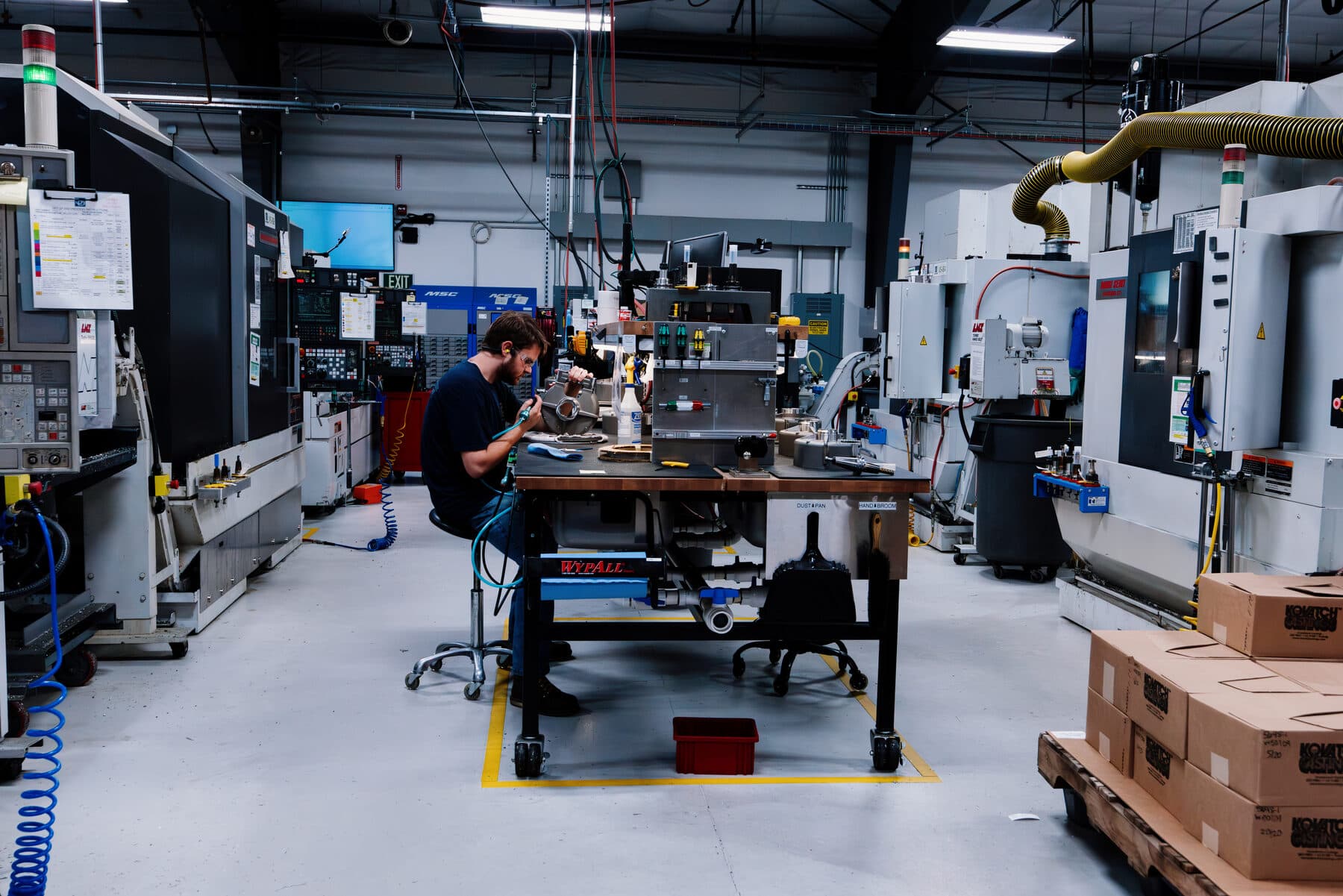
Precision CNC machining uses CAD/CAM programming converted to G code that drives multi axis CNC machines, including dual-spindle CNC turning centers and 4- and 5-axis CNC milling cells, to remove material from stock against a CAD model. Milling machines at JD Machine run tolerances of ±0.001″ on high-temp alloys, including titanium, stainless steel, Inconel, aluminum, and hard plastics.
According to the National Institute of Standards and Technology, high-end mechanical parts sometimes require accuracy of a few micrometers, which is why high precision machining depends on measurement systems and process control as much as on the machine tool itself. Precision is repeatability and reproducibility across runs, not a single conforming part. Calibrated dimensional metrology traceable to the SI meter is the foundation.
Here at JD Machine, we engineer every precision machining process offline using advanced CAM software and CNC simulation software before any chip is cut. OEE and throughput are tracked up-to-the-minute on every precision machine. Lean Manufacturing principles have been embedded across the shop since 1998.
Benefits of Precision CNC Machining
Repeatable Tolerances Across Production Runs
JD Machine holds tight precision of ±0.001″ across the run, not just on the first article. CNC precision machining means high repeatability and reproducibility, per NIST TN 1297. CAD/CAM simulation and PFMEA-driven Standard Work Instructions hold machined parts to spec from the first unit through the last.
Certification-Ready Components for Regulated Programs
Aerospace, defense industry, and medical buyers need supplier visibility under the 9100 series. JD Machine operates an ISO 9001:2015 and AS9100D third-party registered quality system, with CMMC Level 2 for CUI-related projects. The IAQG maintains OASIS specifically to list 9100-certified suppliers buyers can verify directly.
Production-Scale Capacity for Medium-to-High Complexity Work
Our process is engineered for medium to high volume production runs, not one-off prototyping. Vendor Managed Inventory and Just-In-Time pull replenishment keep finished parts moving into customer lines without schedule disruption, from machining time through final delivery.
Our Precision CNC Machining Capabilities
Part geometry, feature access, and material drive whether milling or turning is the right approach.
CNC Turning
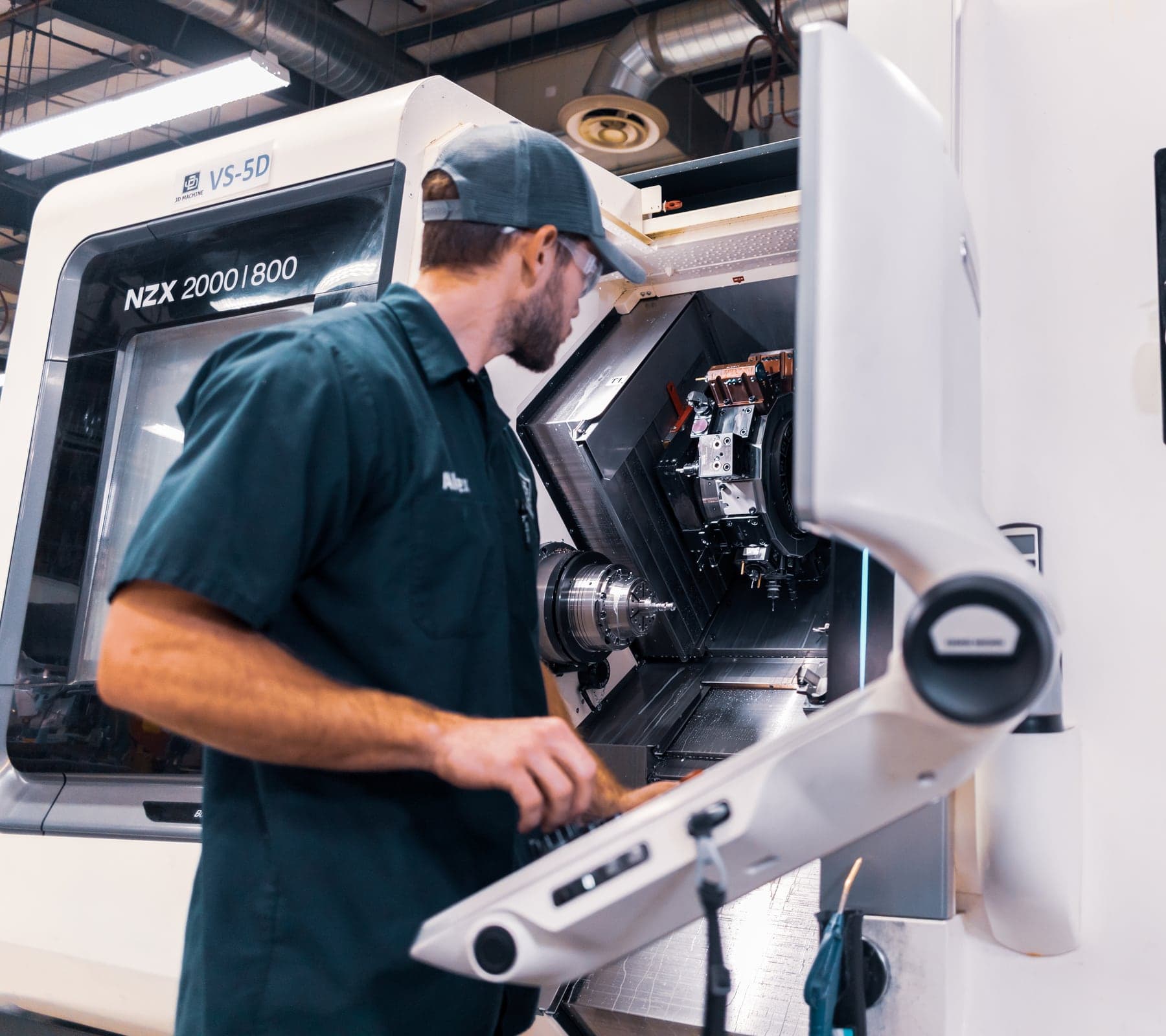
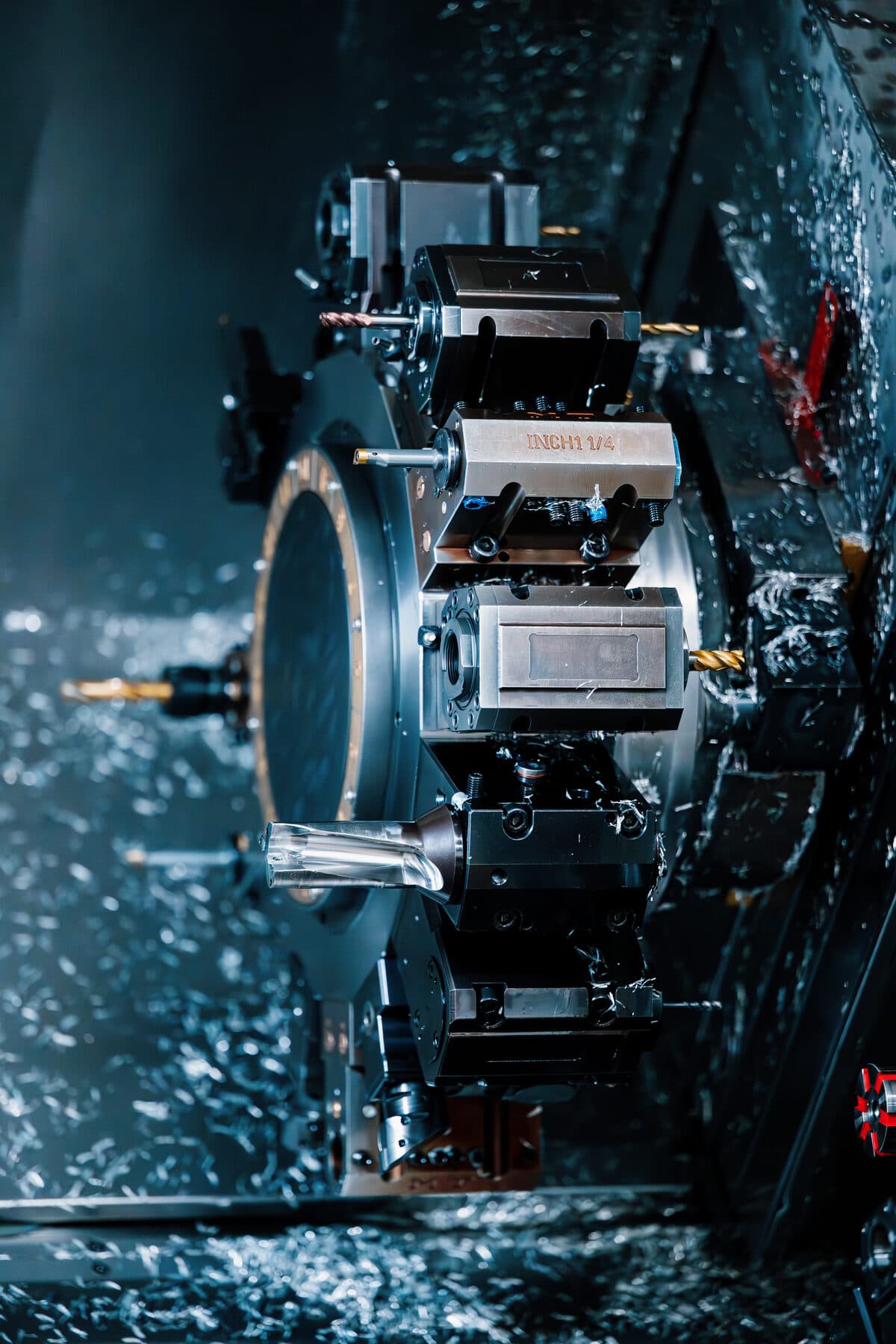
Dual-spindle, multi-turret CNC turning centers with 4-axis milling capability handle straight, conical, curved, and grooved parts. Turning machines at JD Machine reach a max outer diameter of 12″ (30.48 cm). Materials run from stainless and tungsten to nickel-based alloys and PTFE.
- Best for: Cylindrical or rotationally symmetric production parts.
CNC Milling
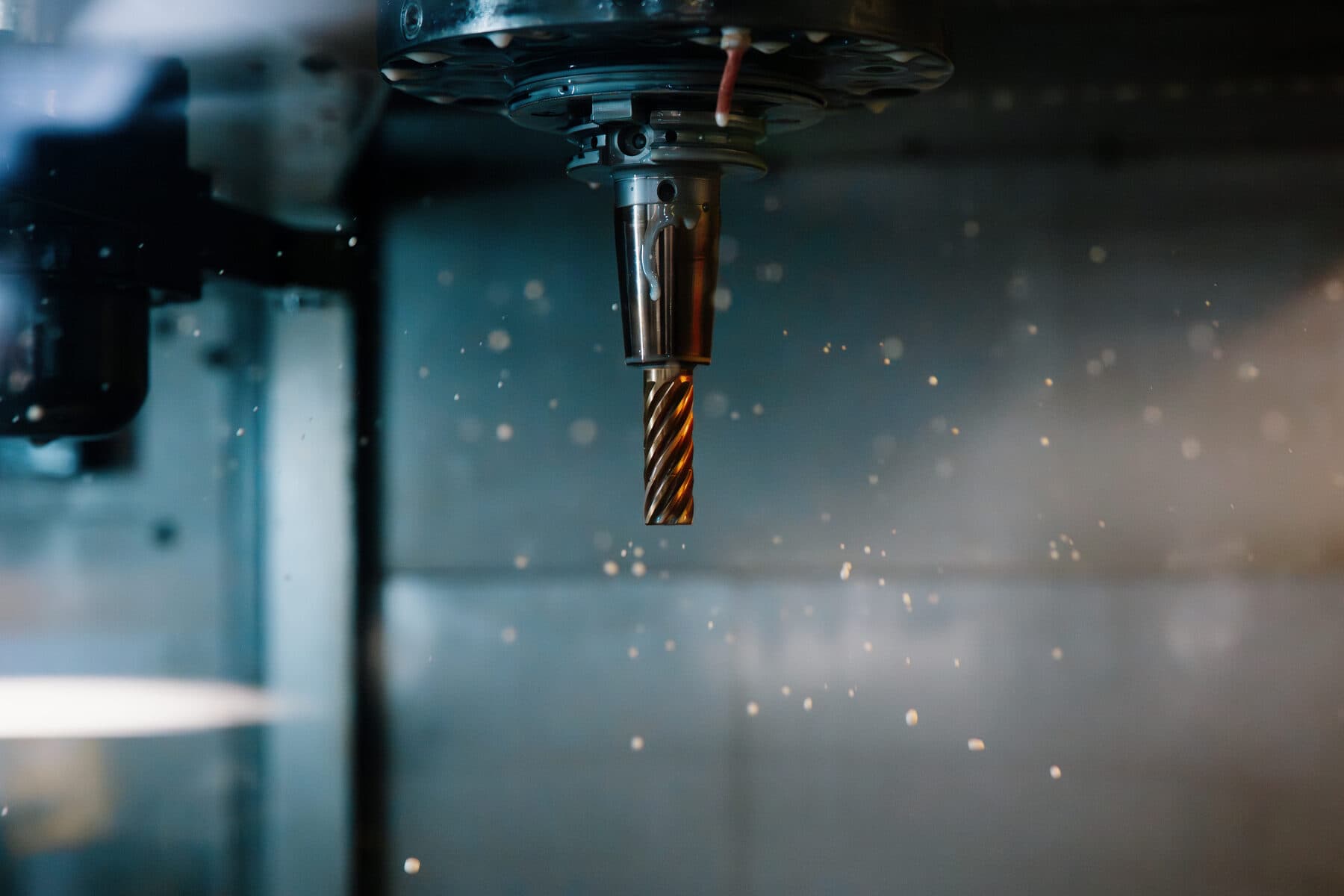
4- and 5-axis CNC milling driven by G code and computer aided manufacturing software produces curves, slots, angled shapes, holes, and channels. Multi axis CNC milling machines achieve tolerances of ±0.001″ on high-temp alloys including titanium, steel, aluminum, and hard plastics.
- Best for: Prismatic parts and intricate designs.
Precision CNC Machining vs. Standard Machining
Both precision CNC machining and conventional machining methods have a place. The right choice depends on tolerance class, repeatability needs, and program risk.
| Factor | Precision CNC Machining | Standard / Conventional Machining |
|---|---|---|
| Tolerance class | ±0.001″ or tighter, repeatable | Wider tolerances, run-dependent |
| Control method | CAD/CAM + G code, multi-axis | Manual or single-axis operator-controlled |
| Repeatability across runs | High; tied to metrology and process controls | Variable across operators and setups |
| Best fit programs | Aerospace, defense, medical, energy | Lower-risk, lower-tolerance commercial work |
| Quality system fit | AS9100D or ISO 9001 traceable | General quality controls, less buyer visibility |
CNC precision machining wins when buyers need repeatable sub-thousandth tolerances, regulated-program traceability, or production-scale consistency. Standard machining can still be the right call for low-risk, wider-tolerance parts where material costs and the cost of metrology and certified quality systems are not justified by the program.
Source: NIST, IAQG, BLS
Who Needs Precision CNC Machining
According to IBISWorld, there are 16,619 machine shop services businesses in the United States in 2026, which makes supplier screening critical. Not every program needs precision CNC machining; here is when it fits.
Aerospace and Defense Programs
Programs requiring 9100-series supplier visibility, ITAR-controlled documentation, or CMMC Level 2 for CUI-related projects need a supplier whose quality system is third-party registered, not asserted. The industries we serve span aerospace, space exploration, and defense. Precision machined parts for the aerospace industry often include engine components and satellite components that demand dimensional accuracy traceable to recognized standards.
Medical and Energy Components
Medical implants, surgical instruments, and energy components carry traceability and inspection demands that benefit from PFMEA-driven Standard Work Instructions and in-house pressure, leak, and conductivity testing. Custom implants and other high precision parts require CNC machining services with certified quality systems.
Production Runs at Medium-to-High Complexity
Buyers with recurring production needs at quantity 50 and above, multi-feature geometries, or sub-thousandth tolerances need a supplier engineered for repeatability across runs, not one-off jobs. Complex parts with close tolerance requirements benefit from precision manufacturing systems built for production scale.
When Precision CNC Machining Might NOT Be the Right Fit
Single-unit prototypes, low-tolerance commercial parts where wider tolerances meet the print, or programs that need rapid one-off design iteration may be better served by prototype shops or conventional machining methods.
What to Expect: Our Precision CNC Machining Process
Request a Quote
You submit your drawing, specs, and quantity through our quote form; expect a response in less than one business day.
CAD/CAM Programming and CNC Simulation
Our team programs your part using computer aided design and simulates the full cycle offline before any chip is cut. CNC technology and precision machining tools are selected based on part geometry and material.
Production Machining and In-House Assembly
Parts run through CNC milling, turning, and downstream assembly under PFMEA-driven Standard Work Instructions. Cutting tools and machine tool calibration are verified before each production run to achieve tolerances consistently.
Testing, Inspection, and Delivery
You receive parts after dimensional inspection and functional testing such as pressure, helium leak, or electrical conductivity as required. Finishing processes including deburring, anodizing, and coating are completed before final delivery timelines are confirmed at quote acceptance.
Why Choose JD Machine for Precision CNC Machining
According to IBISWorld, the U.S. Machine Shop Services industry is a $47.8 billion market in 2026, which means buyers are screening suppliers in a large, fragmented field. JD Machine separates from that field through ISO 9001:2015 and AS9100D third-party registered quality systems, a 99.6% customer quality rating sustained over the last decade, and CAD/CAM-engineered processes built for production repeatability. The JD Machine Difference is how we frame this discipline internally.
Most shops claim tight tolerances and on time delivery. We document both: PFMEA-driven Standard Work Instructions, calibrated metrology, OEE and throughput tracked on every machine, and a 9100-series quality system buyers can verify directly through OASIS. Across many industries, shops produce precision machined parts with similar precision machining tools and CNC machinery, but few maintain the workforce depth and quality system rigor required for aerospace and defense programs.
Our manufacturing process integrates electrical discharge machining (wire EDM), precision grinding, and plasma cutters alongside 5 axis CNC milling machines and turning centers to handle the full range of production geometries. We reduce costs through Lean Manufacturing principles while maintaining higher accuracy than most shops can document.
Frequently Asked Questions
How much does precision CNC machining cost?
Precision CNC machining is quoted per part based on quantity, material, size, design features, and tolerance requirements. JD Machine quotes precision CNC machining on a per-part basis. Cost drivers include quantity, material choice (titanium and Inconel cost more than aluminum), feature complexity, tolerance class, and required secondary processing. Most customers receive a quote response in less than one business day.
When should I choose CNC milling versus CNC turning?
Choose CNC milling for prismatic and multi-feature geometries; choose CNC turning for cylindrical or rotationally symmetric parts. CNC milling produces curves, slots, angled shapes, and holes on prismatic parts using 4- and 5 axis CNC tool paths with a rotating cutting tool. CNC turning produces straight, conical, curved, or grooved features on parts with rotational symmetry, up to 12″ outer diameter. Many production parts at JD Machine use both processes in sequence.
What ongoing support does precision CNC machining require after delivery?
Production parts typically need inventory management, replenishment, and traceability rather than physical maintenance. JD Machine offers Vendor Managed Inventory and Just-In-Time pull replenishment so customers do not run short on critical parts. Supply chain management is a dedicated discipline with professionals and systems handling kitting, replenishment, and supplier oversight. Long-term agreements are preferred for repeat production.
What tolerances can precision CNC machining hold?
CNC milling at JD Machine holds ±0.001″ routinely, with tighter tolerances available on critical features. According to the U.S. Bureau of Labor Statistics, machinists' work sometimes demands accuracy to within 0.0001 of an inch. JDM routinely runs milling tolerances of ±0.001″ on high-temp alloys, with tighter tolerances supported by calibrated metrology and dimensional inspection traceable to recognized standards. High precision parts require automatic tool changers and precision machining tools calibrated to maintain repeatability.
What should I look for in a precision CNC machining partner?
Look for certified quality systems, calibrated metrology, repeatability evidence, workforce depth, and CAD/CAM process control. Certification fit comes first: AS9100D suppliers are listed in the IAQG OASIS database for buyer verification. Beyond certification, ask about metrology and calibration traceability, repeatability across runs (not single-part conformance), workforce stability, and CAD/CAM process control. JD Machine documents each through third-party registration and a 99.6% quality rating sustained over the last decade.
Why does AS9100 matter for aerospace machining?
AS9100 adds aerospace-specific requirements beyond ISO 9001 and gives buyers a verifiable supplier framework. Per NSF, AS9100 was last updated in 2016 and adds aerospace-specific requirements on top of ISO 9001. The IAQG maintains OASIS as the online resource listing suppliers certified under the 9100 series, which means aerospace buyers can verify a supplier's status before issuing an RFQ. Computer numerical control (CNC) suppliers serving other industries may not carry the same certification depth.
Why isn't “tight tolerance” enough to evaluate a CNC supplier?
Tolerance is one measurement; precision requires repeatability and reproducibility across runs and operators. The National Institute of Standards and Technology defines precision as encompassing repeatability and reproducibility. A single conforming part does not prove a supplier can hold close tolerance work across a production run. Process controls, calibrated metrology, and documented Standard Work Instructions are what convert a one-time tolerance claim into reliable production output.
How does machinist labor affect machining quality and lead times?
Skilled machinists drive setup quality, programming accuracy, and run consistency across production batches. According to the U.S. Bureau of Labor Statistics, machinists held about 299,500 jobs in 2024, and the labor pool is under sustained replacement pressure. JD Machine invests in workforce depth through a USDOL-certified apprenticeship program (JDU) and trains team members on CAD/CAM, programming, and inspection to keep production consistency stable.
Is a general machine shop enough for aerospace or defense work?
Not for most programs: regulated work usually requires AS9100D registration and 9100-series supplier visibility. Aerospace and defense programs often require supplier visibility under the 9100 series, traceability for ITAR-controlled work, and CMMC Level 2 for CUI-related projects. A general machine shop without these credentials may machine parts but cannot satisfy supplier qualification. JD Machine carries AS9100D registration and CMMC Level 2 for CUI-related projects.
How many machine shops are there in the United States?
There are 16,619 U.S. machine shop services businesses in 2026, which is why supplier screening matters. Per IBISWorld, there are 16,619 machine shop services businesses in the United States in 2026, and competition is rated high and steady. For buyers, that fragmentation makes a defined supplier evaluation framework (certification scope, metrology capability, workforce depth) more useful than vendor-by-vendor comparison.