


CNC Milling Services for Precision Production Parts
JD Machine pairs AS9100D and CMMC Level 2 quality systems with multi-axis CNC milling services, documented inspection, and traceability built for custom CNC production parts.
How CNC Milling Services Work at JD Machine
CNC milling is a computer numerical control machining process driven by CAD/CAM programs and G-code, running on 4- and 5-axis machines that move a rotating cutting tool against fixtured material stock. The result is prismatic and multi-face parts with pockets, slots, angled features, curves, and holes. These milled parts are produced from titanium, stainless steel, aluminum alloys, carbon steel, mild steel, steel alloy stock, and hard plastics. Milling sits inside JD Machine's broader CNC machining capability.
Effectiveness depends on axis count matched to part geometry, fixturing strategy, programming discipline, and inspection feedback. According to the U.S. Bureau of Labor Statistics, machinist work may demand accuracy to within ±0.0001″, which is why process control and inspection planning matter more than nominal tolerance numbers on a quote.
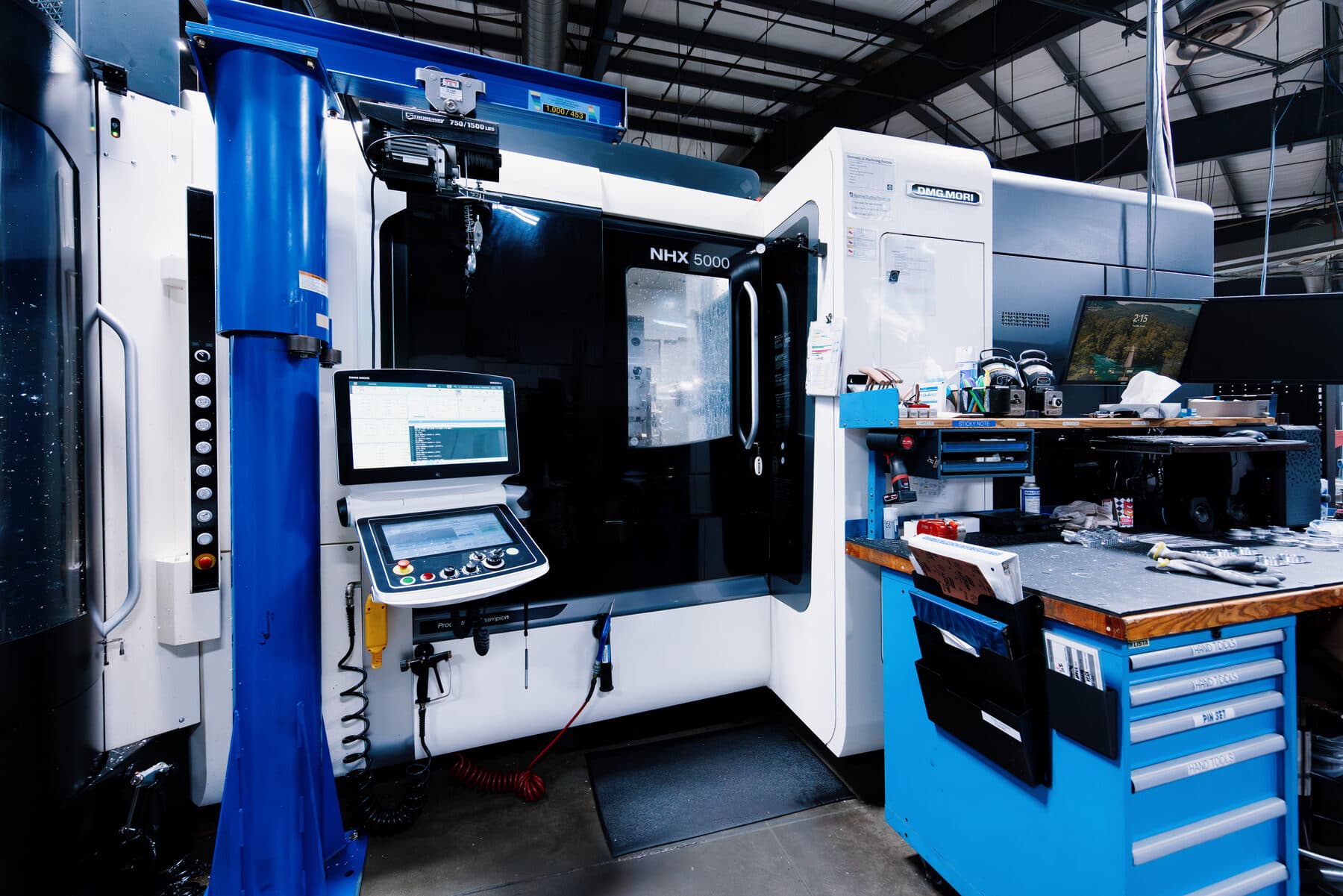
JD Machine programs every job offline using advanced CAD/CAM software and validates each program through CNC simulation before any cut. Up-to-the-minute OEE and throughput tracking runs on every machine, and PFMEA-driven Standard Work Instructions govern setup, run, and inspection. These quality systems carry through to first-article and production inspection, ensuring CNC machined parts meet specification across the CNC machining process. Parts can be delivered as machined or with secondary finishing operations depending on application requirements.
Benefits of CNC Milling Services
Repeatable Tight-Tolerance Production
JD Machine holds tight tolerances of ±0.001″ on milled production parts using CAD/CAM-validated programs and CNC simulation before any cut. The approach supports repeat releases under long-term agreements rather than single-touch prototype runs, delivering reliable performance across production lots with reduced lead time variability and consistent dimensional control on custom CNC machining work.
Documented Quality for Regulated Work
A 99.6% customer quality rating over the last decade reflects an AS9100D and ISO 9001:2015 quality system with PFMEA-driven Standard Work Instructions and material traceability built into every milling job. The same controls flow down to subassembly and inspection records, supporting heat resistance and wear resistance requirements on regulated components exposed to high temperatures and harsh operating conditions.
Material Depth Across Alloys and Plastics
CNC milling at JD Machine covers high-temp alloys including titanium, stainless steel alloys, aluminum alloys, carbon steel, steel alloy stock, and hard plastics with corrosion resistance properties. Material experience shapes tooling selection, fixturing, and inspection planning before the first chip is cut, which protects surface finish, tensile strength, and mechanical properties on harsh-environment parts requiring corrosion resistant performance or high stiffness under load.
Production-Fit Capacity for Long-Term Agreements
Multi-cell milling capacity supports long-term agreements and medium to high volume production runs, fitting buyers planning repeat custom manufacturing releases on CNC parts. Vendor managed inventory and JIT pull options layer on top for lead time stability, with low density materials and steel alloy stock managed through the same system.
CNC Milling vs. CNC Turning
Both CNC milling and CNC turning are precision processes; part geometry, feature mix, and production fit determine the right route.
| Decision Factor | CNC Milling | CNC Turning |
|---|---|---|
| Part geometry fit | Prismatic, multi-face, pockets, slots | Cylindrical, rotational symmetry |
| Tooling motion | Rotating cutter, fixtured part on multi-axis | Rotating part on spindle, stationary cutter |
| Axis configuration | 4- and 5-axis available | Dual-spindle, multi-turret with 4-axis milling |
| Typical tolerance band | ±0.001″ or tighter | Depends on feature and material |
| Best fit | Complex multi-face precision components | Cylindrical parts up to 12″ OD |
When the part carries prismatic features, multiple faces, pockets, or complex geometries, CNC milling wins on setup efficiency and tolerance stack-up. When the part is cylindrical with rotational symmetry and sharp edges off a spindle, CNC turning is the right route. Many JD Machine programs blend both processes within one work order, with metal cutting and sinker EDM available for specialized features.
Source: JD Machine capability data
Who Needs CNC Milling Services
CNC milling fits specific part geometries and production realities; here is how to recognize the right route across the industries we serve.
Aerospace or Defense OEMs Sourcing Production Milled Parts
You have a flight-critical or defense program requiring milled components with AS9100D documentation, material traceability, and CMMC compliant activities. Generic shops can quote the part but cannot support qualification flow-down on metal parts or plastic and metal parts requiring electrical components integration.
Medical Device Manufacturers Releasing Repeat Lots
You produce medical devices needing tight tolerances, documented inspection, and PFMEA-driven process control across repeat lots on CNC machined parts. Prototype-oriented platforms cannot sustain that documentation discipline release after release on CNC parts requiring chemical resistance or electrical insulation properties.
Energy or Mining Programs With Complex Geometry
You need multi-face precision components in titanium, high-temp alloys, or stainless steel for harsh environments. Part geometry rules out turning and demands 4- or 5-axis milling with corrosion-resistant material handling, often at extreme temperatures or high temperatures exceeding 500°F.
Supply Chain Teams Standardizing Suppliers Under LTAs
You are consolidating suppliers under long-term agreements with vendor managed inventory and JIT replenishment. Minimum order quantities sit above prototype thresholds, and you need a partner built for production parts across automotive industries, consumer electronics, and industrial applications.
When CNC Milling Services Might Not Be the Right Fit
If you need a one-off prototype or a single cylindrical turned part, an online CNC machining service or a turning-focused shop may serve you better. JD Machine is geared toward medium to high volume production runs and has stepped back from prototype-only work.
What to Expect from Our CNC Milling Process
Request a Quote
You upload your CAD file and technical drawings to request a quote, and receive a response within 24 hours with lead time estimates and pricing for your custom CNC machining service needs.
CAD/CAM Programming and Simulation
Your part is programmed offline using advanced CAD/CAM software and validated through CNC program simulation before any cut, supporting the CNC machining process from file to finished part.
Precision CNC Milling
Your parts move into 4- or 5-axis milling cells with OEE-tracked throughput and PFMEA-driven Standard Work Instructions, with wire EDM and rapid prototyping capabilities available for specialized geometries.
Inspection and Testing
Your parts undergo documented inspection with material traceability; functional inspection and testing is available where required, including verification of tensile strength, impact resistance, and electrical conductivity on specified features.
Delivery
Your finished parts ship per your schedule, with JIT pull or vendor managed inventory available for repeat releases.
Why Choose JD Machine
According to IBISWorld, the U.S. machine shop services industry is worth $47.8 billion in 2026, with 16,619 businesses competing for precision work.
JD Machine has sustained a 99.6% customer quality rating over the last decade across that landscape, operating under AS9100D and ISO 9001:2015 certifications with CMMC Level 2 compliance for CUI-related projects.
Buyers worry that any shop with mills can win a part but few can support flow-down, traceability, and external-provider controls on custom CNC work. JD Machine's PFMEA-driven Standard Work Instructions, documented inspection records, and material traceability address those AS9100D and CMMC requirements directly on every production part, with CNC machining advantages including powder coating, zinc plating, and sheet metal integration available through the same manufacturing process.
Frequently Asked Questions
How much do CNC milling services cost?
CNC milling cost depends on geometry, material, tolerance, setup count, and whether your supplier is built for prototypes or production. Pricing is quote-based and driven by quantities, material, size, design, and features. Small geometry choices like tight internal fillets and chamfers add tool changes and setup time, so DFM review often lowers cost on production parts. Material selection affects cost directly, with mild steel and free machining brass running lower than titanium or corrosion resistant alloys. JD Machine is geared toward medium to high volume production runs and responds to quote requests within 24 hours.
What is the difference between CNC milling and CNC turning?
CNC milling suits prismatic and multi-face parts; CNC turning suits cylindrical and rotational parts. Many JD Machine programs blend both CNC machining processes within a single work order, because turning centers carry 4-axis milling capability and a cylindrical body may need a milled flat, pocket, or cross-hole. Material traceability and documented inspection apply across both routes, so qualification records stay consistent regardless of which process handles which feature.
What ongoing support does JD Machine provide for CNC milling production?
JD Machine supports CNC milling production with vendor managed inventory, JIT pull replenishment, and long-term agreement structures. VMI services include monitoring customer inventory levels, replenishing stock, parts kitting, and supply chain management around the production schedule. PFMEA-driven Standard Work Instructions and documented inspection records carry across repeat lots, which protects mechanical properties, surface finish, and dimensional consistency release after release on plastic parts, metal parts, and hybrid assemblies.
What is CNC milling service?
CNC milling service is computer-controlled cutting of prismatic and multi-face parts from solid material stock using CAD/CAM-driven multi-axis machines. The cutting tool rotates while the part stays fixtured, and motion across 4 or 5 axes produces pockets, slots, angled faces, holes, and contoured surfaces. JD Machine runs 4- and 5-axis milling cells with offline CAD/CAM programming and CNC simulation, supporting custom CNC machining for production parts rather than one-off prototype work. CNC machining applications span aerospace, defense, medical, energy, and automotive industries, with online CNC machining services typically focused on prototype volumes.
How should I prepare my file for CNC machining?
Submit a CAD file plus a technical drawing with tolerances, material callouts, surface finish, and any critical features explicitly noted. Call out general tolerances on the drawing, then flag tighter tolerances on the specific features that need them. Note threads, finishes, and inspection requirements. Small internal fillets, deep narrow pockets, and tight chamfers drive cost, so highlight whether those features are functional or open to DFM adjustment. If the part requires excellent corrosion resistance, excellent chemical resistance, or excellent wear resistance, specify the environment and exposure conditions. For plastic parts requiring low friction or low moisture absorption, note the operating environment.
What tolerances can CNC milling hold?
Achievable tolerance depends on feature, material, fixturing, and inspection plan, not a single marketing number. JD Machine holds tight tolerances of ±0.001″ on milled production parts depending on feature and material. Materials with low friction coefficients or good mechanical properties may hold tighter tolerances with proper fixturing.
Why do CNC milling quotes vary so much?
Quote variation reflects setup time, tooling, fixturing, tolerance band, inspection plan, and whether the shop is built for prototypes or production. Some shops respond slowly or skip DFM review, then surface cost surprises during machining. JD Machine returns quotes within 24 hours and structures pricing around production fit, with PFMEA-driven Standard Work Instructions and documented inspection priced into the job rather than added later. Material choices like PVC polyvinyl chloride, epoxy resin, or sheet metal stock affect pricing based on machinability and tooling requirements.
Are online machining services or production-oriented suppliers better?
Online platforms suit fast prototype quotes; production-oriented suppliers suit qualification, traceability, and repeat releases. If you need a single part in a week with no documentation requirements, an online CNC machining service is efficient. If you need AS9100D flow-down, CMMC compliant activities, material traceability, and consistent CNC machined parts across long-term agreements, JD Machine is built for that path with medium to high volume production runs and VMI support. Online CNC machining services typically lack the quality systems needed for regulated work requiring UV resistance, low moisture absorption, or excellent electrical insulator properties.
When does AS9100D matter for CNC milling services?
AS9100D matters whenever your milled component touches aerospace, space, or defense work requiring documented external-provider controls and traceability. Per NQA, AS9100D requires the buyer to define criteria for evaluation, selection, monitoring, and reevaluation of external providers. JD Machine is AS9100D and ISO 9001:2015 certified with CMMC Level 2 status, which satisfies the external-provider portion of the standard for milled components under regulated programs requiring creating fixtures, tooling validation, and documented process control.
How long do CNC milling lead times typically run?
Lead times depend on quantity, geometry, material availability, and current shop capacity across a labor-constrained market. According to the U.S. Bureau of Labor Statistics, about 34,200 openings for machinists and tool and die makers are projected each year over the decade, which constrains industry-wide capacity. JD Machine maintains production-fit capacity across 4- and 5-axis milling cells and supports lead time stability through long-term agreements and JIT replenishment, with custom CNC parts delivered on schedule.