

Precision CNC Turning Services for Production Programs
JD Machine runs dual-spindle, multi-turret CNC lathe machines with 4-axis milling capability, turning precision parts up to 12 inch outside diameter for regulated production programs.
How CNC Turning Works at JD Machine
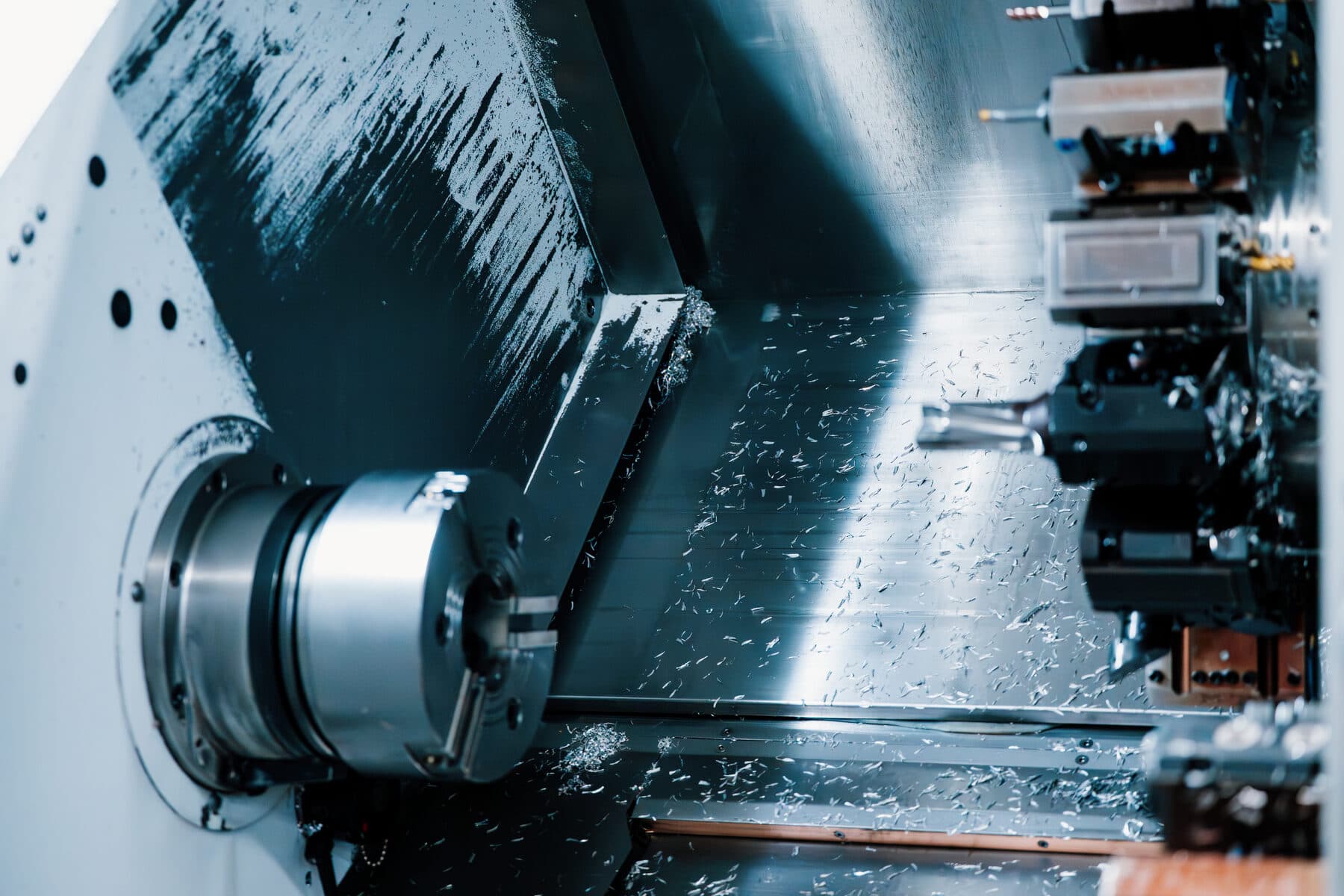
CNC turning rotates cylindrical stock against a stationary cutting tool to remove material and produce rotation-symmetric features. JD Machine's CNC lathes run a dual-spindle, multi-turret configuration with 4-axis milling capability, handling cylindrical components up to 12 inch (30.48 cm) outside diameter in stainless steel, carbon steel, aluminum, nickel-based and high-temp alloys, brass, copper, bronze, nylon, and PTFE.
Every job is programmed in CAD/CAM and validated through CNC program simulation before the spindle starts, so toolpath, workholding, and cycle time get proven offline. OEE and throughput are tracked up-to-the-minute on every CNC machine. Live tooling on the CNC lathes cuts axial and radial holes, flats, grooves, and slots in a single setup, which compresses cycle time and reduces dimensional drift from extra workholding moves.
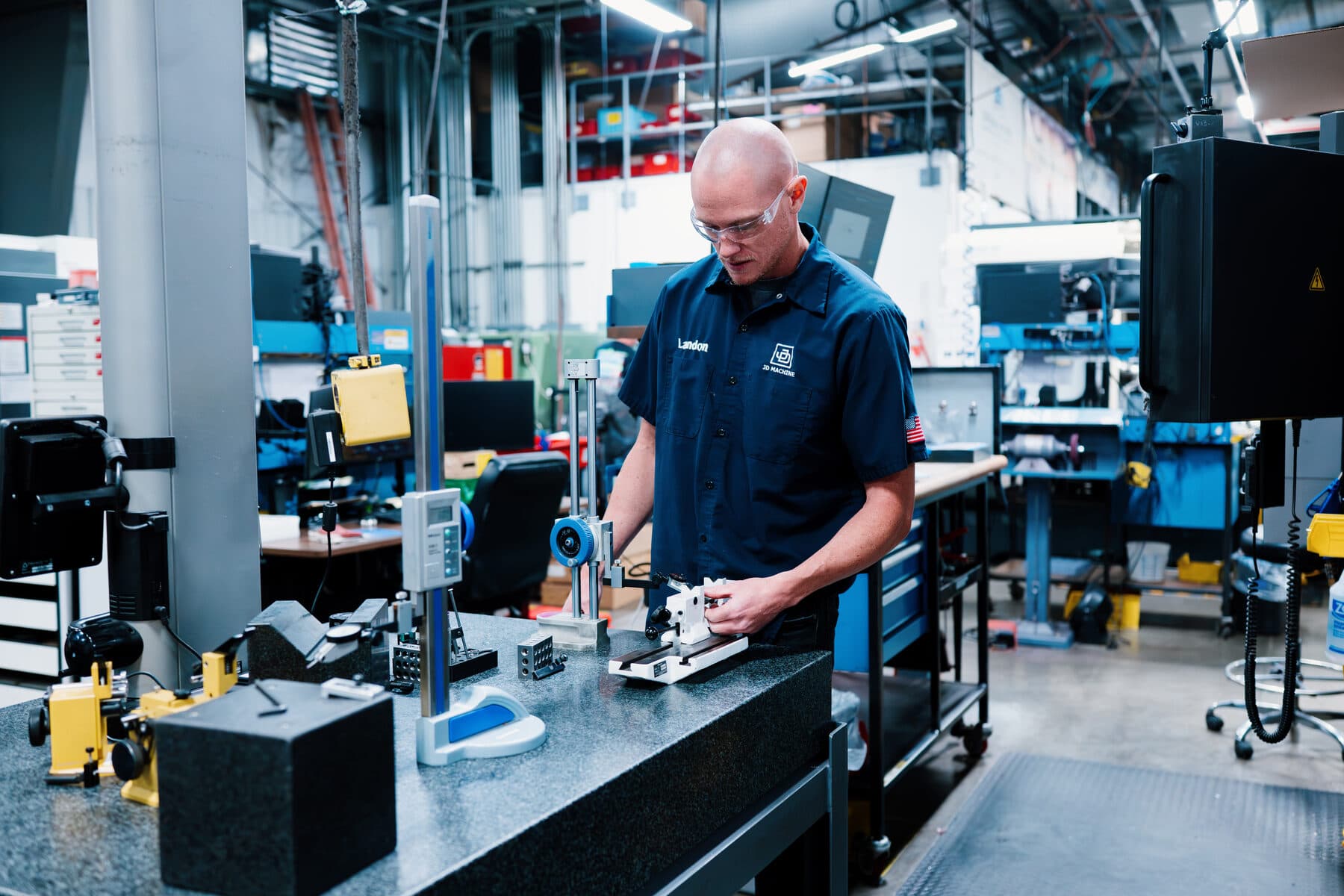
Lean Manufacturing principles have governed setup, changeover, and work-in-process at JD Machine since 1998. PFMEA-driven Standard Work Instructions control every machining operation, and inspection cadence runs under an AS9100D and ISO 9001:2015 quality system with first-article and in-process measurement across the production run. Request your CNC turning quote - typical response under one business day.
Benefits of CNC Turning Services
Fewer Setups Through Single-Operation Turning
Live tooling on JD Machine's multi-turret CNC lathe machines cuts axial and radial holes, flats, grooves, and slots without moving the part to a separate mill. Fewer workholding moves means tighter dimensional accuracy across features and shorter cycle times on full scale production runs. This single-setup approach delivers high accuracy on complex geometries while maintaining cost effective production throughput.
Tolerance Held Through Process Control, Not Promises
CAD/CAM programming with offline CNC simulation, PFMEA-driven Standard Work, and OEE tracking on every lathe keep dimensional accuracy under control through the production run. Tight tolerances hold across the batch, not just on the first article. Precision CNC turning operations maintain consistent dimensional control on turned parts from first article through final piece.
Production Capacity When Supplier Labor Is Tight
Per the U.S. Bureau of Labor Statistics, about 34,200 openings for machinists and tool-and-die makers are projected each year over 2024 to 2034. JD Machine's in-house workforce and Machinist Apprenticeship pipeline keep production capacity stable on long-running CNC turning contracts.
Material Range for Aerospace, Defense, and Energy Work
Production turning runs across stainless steel, carbon steel, aluminum, nickel-based and high-temp alloys, brass, copper, bronze, nylon, and PTFE on the same shop floor. One supplier covers the material stack the industries we serve require, without requalifying a new vendor every program. Material selection accounts for wear resistance and corrosion resistance requirements across aerospace, defense, medical, and energy applications.
CNC Turning vs. CNC Milling
CNC turning and CNC milling are complementary machining processes. The correct choice is driven by part geometry, feature set, and production volume.
| Criterion | CNC Turning | CNC Milling |
|---|---|---|
| Best part geometry | Cylindrical, rotation-symmetric, OD up to 12″ | Prismatic, pocketed, flat-sided, complex contours |
| Primary motion | Stock rotates; tool stationary | Tool rotates; stock fixed or indexed |
| Secondary features | Axial/radial holes, flats, slots via live tooling | Pockets, complex 3D surfaces, deep cavities |
| Setup count for cylindrical parts | One setup with live tooling on multi-turret center | Multiple setups for OD features |
| Typical general tolerance | ±0.005″ general, tighter by spec | ±0.001″ or tighter |
CNC turning is the right call when the part is rotation-symmetric and benefits from being held in a spindle, especially when live tooling can finish secondary features in a single setup. CNC milling wins when the part is prismatic, pocketed, or carries complex non-rotational geometry. Many programs at JD Machine use both CNC machining services. Single-setup machining reduces tolerance stack-up and shortens cycle time compared to moving the part to a separate CNC lathe machine for secondary operations.
Source: Industry standards (process selection); Xometry (tolerance benchmark)
Who Needs CNC Turning Services
Not every rotational part calls for production CNC turning. Here is when this capability fits.
Aerospace and Defense OEMs Qualifying a Production Supplier
You need an AS9100D and ITAR-cleared shop for CNC turned parts on a flight program or controlled assembly. Documentation depth, first-article reporting, and CMMC Level 2 readiness matter as much as cycle time. Precision CNC turning services under a registered quality system support regulated industries with full traceability.
Medical and Energy Programs Sourcing Tight-Tolerance Cylindrical Parts
Your design has shafts, housings, or fittings with rotation-symmetric features and tolerance call-outs that need measurement discipline behind them. Per IBISWorld, 16,619 U.S. machine shop services businesses compete for this work in 2026. Screening rigor matters. Skilled machinists and precision parts documentation separate production suppliers from job shops.
Procurement Teams Setting Up Long-Term Agreements for Repeat Production
Your annual demand is steady, your volumes are medium to high, and you want a supplier that supports vendor-managed inventory, JIT pull replenishment, and capacity planning across multiple part numbers. CNC lathe services integrated with VMI and pull systems reduce lead times and inventory carrying costs.
When CNC Turning Might NOT Be the Right Fit
If you need a one-off prototype, a single piece below quantity 50, or a part with primarily prismatic geometry, CNC milling or a prototype-first vendor is the better path. JD Machine is built for production, not single-piece rapid prototyping work.
What To Expect: Our CNC Turning Process
Request Your Quote
You submit drawings, specs, and quantity through the Get a Quote form. JD Machine typically responds in less than one business day.
CAD/CAM Programming and CNC Simulation
Our manufacturing engineers program and simulate the toolpath offline before any cycle starts, validating tolerance, setup, and cycle time. The CAD file drives machining operations from initial programming through final inspection.
Machining and Fabrication
Your parts run on dual-spindle, multi-turret CNC turning machines with live tooling, monitored by real-time OEE tracking. Skilled machinists oversee each production run to ensure intricate parts meet exact specifications. CNC turning operations run at high speeds on aluminum and brass stock, with adjusted parameters for stainless steel and nickel-based alloys.
In-House Assembly, Testing, and Inspection
PFMEA-driven Standard Work governs assembly and test, including pressure tests, helium leak tests, and electrical conductivity checks where required.
Delivery and Replenishment
You receive completed parts with documentation under the AS9100D and ISO 9001:2015 quality system, plus VMI or JIT pull replenishment for repeat programs.
Why Choose JD Machine for CNC Turning Services
According to IBISWorld, the U.S. machine shop services industry is worth $47.8 billion in 2026. In a market that fragmented, qualified suppliers are the exception, not the default. JD Machine runs precision CNC lathe services under an AS9100D, ISO 9001:2015, CMMC Level 2, and ITAR-registered quality system built for regulated production work.
CNC turning may look interchangeable on paper, but the cheapest quote rarely covers the documentation depth that aerospace, defense, and medical programs require. JD Machine holds Boeing Silver Supplier status and ATK Supplier of the Year recognition, and hosts customers who visit to benchmark The JDM Difference in QMS, ERP, and production systems.
About JD Machine
JD Machine is a multi-generational, family-owned precision machining and fabrication company founded in 1979 and headquartered in Ogden, Utah. JD Machine serves aerospace, space exploration, defense, medical, energy, mining, and commercial customers nationally. The company is AS9100D, ISO 9001:2015, CMMC Level 2, and ITAR registered, operates from a 100,000 sq ft facility with 230+ team members, and has sustained a 99.6% customer quality rating over the last decade.
Frequently Asked Questions
How much do CNC turning services cost?
CNC turning is quote-based; cost depends on quantity, material, part geometry, tolerance, secondary features, and finish requirements. Pricing varies across every CNC turning quote because the cost drivers stack: order quantity, material grade (aluminum vs. nickel-based alloy), outside diameter and length, tolerance tightness, live-tool secondary operations, and surface finish. JD Machine returns most quotes in less than one business day after drawings and specs come in through the Get a Quote form. CNC lathe machine setup and programming costs are amortized across production runs, making higher volumes a cost effective option.
What is the difference between CNC turning and CNC milling?
CNC turning rotates the part against a stationary cutting tool for cylindrical work; CNC milling rotates the tool against a fixed part for prismatic geometry. The decision comes down to motion, geometry fit, and how secondary features get handled. Turning is typically faster for rotation-symmetric parts because the spindle does the work. When a cylindrical part also needs holes, flats, or slots, multi-turret CNC turning centers with live tooling often finish those features in the same setup, eliminating a separate milling step entirely.
What ongoing support does JD Machine provide for CNC turning programs?
Production turning programs at JD Machine include vendor-managed inventory, JIT pull replenishment, and capacity planning across repeat part numbers. Long-term agreements are the preferred model. JD Machine monitors customer inventory levels, replenishes parts on a pull system, manages kitting for assembly components, and coordinates the production schedule to prevent disruptions. Supply chain management is a dedicated function, not a side activity, which keeps repeat programs running without surprise stockouts.
What tolerances can CNC turning hold?
General CNC turning tolerances commonly land near ±0.005 inch, with tighter tolerances achievable when specified. According to Xometry, general CNC turning tolerances are commonly around ±0.005 inch, with tighter ranges possible by specification. The figure on the print is only part of the answer. CAD/CAM simulation, PFMEA-driven Standard Work, and AS9100D inspection cadence are what hold dimensional accuracy across a production batch rather than just the first article.
Can CNC turning make axial and radial holes, flats, and slots?
Yes. Live tooling on multi-turret CNC turning centers handles axial holes, radial holes, flats, grooves, and slots in a single setup. Live tooling on dual-spindle, multi-turret CNC turning centers adds rotating cutters to the turret, so the part stays in one workholding while milling features are cut. Single-setup machining reduces tolerance stack-up and shortens cycle time compared to moving the part to a separate CNC lathe machine for secondary operations.
What materials can JD Machine turn?
JD Machine turns stainless steel, carbon steel, aluminum, nickel-based and high-temp alloys, brass, copper, bronze, tungsten, magnesium, nylon, and PTFE. The material list covers the alloy stack that aerospace, defense, medical, and energy programs typically require, including titanium-family high-temp alloys, Inconel-class nickel alloys, and aluminum 6061. Material selection is reviewed during quoting against tolerance, surface finish, and corrosion resistance requirements so the cutting strategy fits the spec. Steel alloy grades and aluminum parts are machined at high speeds to maintain competitive pricing across various industries.
Is CNC turning right for prototypes or production runs?
JD Machine is built for production, geared toward medium to high volume production runs with no prototype-first workflow. Prototype-first vendors are optimized for one-off pieces, design iteration, and rapid turnaround. Production suppliers like JD Machine are optimized for repeat programs, long-term agreements, and qualified-supplier work under a registered quality system. If you need a single proof-of-concept turned part, a rapid prototyping vendor is the right call. Production parts benefit from the numerous advantages of CNC turning at scale, including cost effective options for high volume runs.
How do I evaluate a CNC turning supplier?
ASQ recommends evaluating quality system sophistication, delivery capacity, technical support, prior performance, financial stability, and regulatory fit. According to ASQ, supplier selection criteria include quality system sophistication, delivery capacity, technical support, prior performance, financial stability, and regulatory requirements. Ask for certification scope, on-time delivery data, first-article reports from comparable parts, and proof of regulatory fit (AS9100D, ITAR, CMMC Level 2) before issuing a PO.
Why do AS9100 and CMMC matter for CNC turning services?
AS9100D governs aerospace quality systems; CMMC Level 2 governs CUI handling for defense work. Buyers in those sectors typically require both. AS9100D is the aerospace quality management standard built on ISO 9001 with sector-specific risk, configuration, and first-article requirements. CMMC Level 2 is the U.S. Department of Defense cybersecurity certification required for handling Controlled Unclassified Information on CUI-related projects. JD Machine is registered to both, along with ISO 9001:2015 and ITAR, under one quality systems framework.
What is the minimum quantity for a CNC turning quote at JD Machine?
JD Machine is geared toward medium to high volume production runs rather than single-piece work. That scope reflects a business decision rather than a capacity limit. Programming, simulation, fixturing, and first-article documentation overhead are sized for repeat production runs. Buyers needing one-off turned parts for design validation are better served by a prototype-first vendor, then can transition to JD Machine when the design moves to production. Send the drawing and quantity and we will confirm fit on the quote.