


Manufacturing Logistics Services Built for Production Continuity
JD Machine runs manufacturing logistics services on a JIT pull system and vendor managed inventory discipline grounded in lean manufacturing since 1998.
How Manufacturing Logistics Actually Moves Through Production
Production logistics begins at inbound receiving and ends at finished goods delivery, with raw materials staging, WIP flow, and supplier coordination in between. Each handoff is tied directly to a production schedule, which is where competitors gloss the work.
Accurate inbound receiving and on-time supplier coordination are the failure points that cascade into missed production starts. According to the CSCMP 2025 Third-Party Logistics Study, 68% of shippers named control tower visibility their top must-have capability for specialized manufacturing logistics services. Visibility-grade execution requires real time tracking, accurate inbound receiving, transportation planning, and exception escalation tied to production schedules, not a status dashboard reviewed after a problem hits.
JD Machine's approach pairs vendor managed inventory with a just in time pull system synchronized to customer production cadence. VMI monitors inventory levels and replenishes against demand forecasting; the pull system aligns parts delivery to actual line consumption.
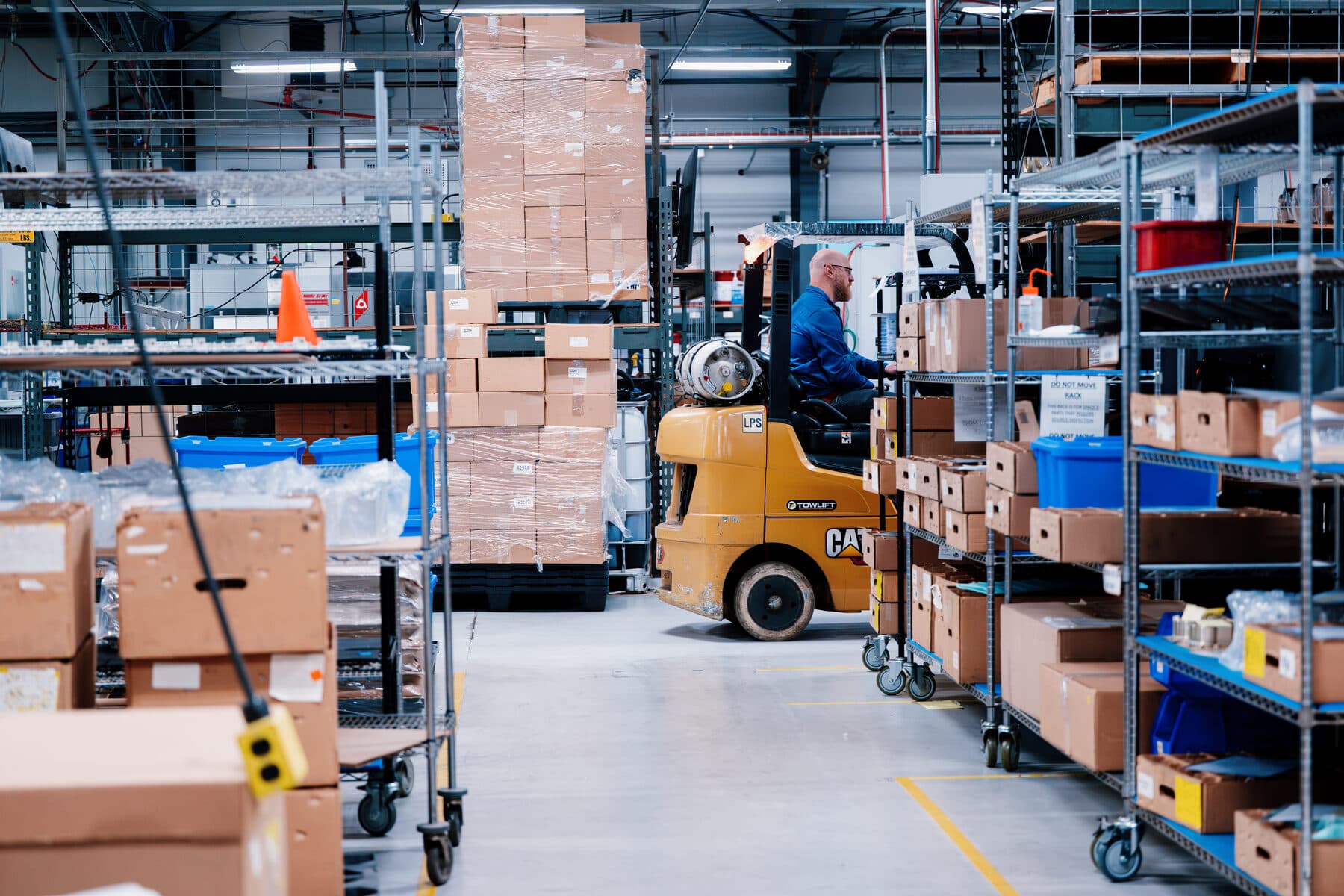
Raw materials flow directly to production lines without excess staging, while materials and components move through the supply chain on measured cadence. Lean Manufacturing discipline since 1998 means storage costs, lead times, and throughput are measured against the operation, not estimated.
What Production-Aligned Logistics Changes
Inventory Discipline That Protects Working Capital
VMI and JIT pull reduce excess inventory by tying replenishment to actual consumption rather than forecast buffer. Effective inventory management matches production cadence, storage costs drop, and supplier coordination operates against a single demand signal. Lean Manufacturing discipline since 1998 anchors the inventory targets to measured throughput, which helps manufacturers reduce costs tied to working capital and optimize routes for raw materials delivery.
Insulation from Freight Inflation
Per the U.S. Bureau of Labor Statistics, transportation and warehousing prices were up 5.0% year over year in April 2026, which raises the cost of reactive freight management for manufacturing companies. Transportation planning with optimized routes and JIT discipline replace reactive expedites with scheduled execution, improving efficiency across the supply chain. Manufacturing freight planning that accounts for route optimization reduces both transit time and fuel costs, helping manufacturers control costs in volatile markets.
Production-Schedule Reliability
PFMEA-driven Standard Work Instructions, OEE tracking, and ERP integration hold the operation accountable to the production schedule across multiple suppliers. Lead times stabilize because supplier coordination is a managed competency, not a calendar reminder. The quality systems layer extends the same discipline used in machining and assembly to logistics execution, which drives customer satisfaction through on-time delivery to customers.
Outsourced Manufacturing Logistics vs. In-House Logistics Management
Both models are valid. Internal logistics teams work when volume is stable, the network is simple, and systems are mature. Outsourcing wins when complexity outpaces internal capacity. Unlike general logistics, manufacturing and logistics integration requires precise coordination with production facilities and supplier networks.
| Evaluation Dimension | In-House Logistics | Outsourced Manufacturing Logistics |
|---|---|---|
| Selection driver | Internal control over execution | Reliability and accuracy (32.1% top criterion) |
| Systems requirement | Build TMS + WMS internally | Use partner control-tower visibility (68% must-have) |
| Scale ceiling | 47% of brands report scale challenges | Capacity scales with provider network |
| Switch trigger | Internal turnover, systems gaps | Poor service quality (33.0% top switch reason) |
| Best when | Stable volume, simple network | Multi-supplier complexity, schedule sensitivity |
In-house logistics wins when volume is stable and internal systems already deliver visibility. Outsourced manufacturing logistics wins when supplier coordination, inbound accuracy, or JIT replenishment outpace internal bandwidth. Per the Transport Intelligence 3PL Procurement Trends Survey, the decision turns on execution risk, not on which model sounds cheaper on paper. Choosing the right manufacturing logistics partner means evaluating advanced technology capability alongside service quality and cost efficiency. Logistics capabilities that integrate with existing manufacturing operations deliver the strongest results for customers facing complexity.
Source: Radial 2025; Transport Intelligence 2024; CSCMP 2025
Who Needs Manufacturing Logistics Support
Not every manufacturer needs outsourced logistics support. Here is how to recognize when production exposure justifies a partner.
Multi-Supplier Programs Hitting Coordination Limits
Programs running across multiple suppliers tend to surface coordination gaps before they surface inventory ones. Signs include missed inbound windows, phantom stock against the ERP, and schedule slips traced back to communication lag rather than capacity. Many manufacturers face increasingly complex supplier networks that strain internal coordination systems and production lines.
Aerospace, Defense, or Medical Programs Under Compliance Pressure
Regulated programs extend AS9100D, CMMC, and ITAR requirements to logistics partners. Signs include audit findings on chain-of-custody, supplier qualification gaps, and CUI-related projects that internal logistics teams are not cleared to handle. Certain sectors in the manufacturing industry require specialized handling that general logistics providers cannot support.
Programs Where Schedule Disruption Costs More Than Freight
When a missed production start costs more than a freight surcharge, the calculus shifts. Signs include production delays mislabeled as inventory issues, weak issue-escalation visibility, and reactive expedite spend that exceeds the original freight budget. Manufacturers rely on production logistics partners when keeping production lines moving becomes the core operational priority and when costs from disruption exceed freight premiums.
When Manufacturing Logistics Might NOT Be the Right Fit
Single-product runs under quantity 50, prototyping-only engagements, and design-collaboration programs are not a fit. JD Machine does not quote under quantity 50 and is no longer set up for prototyping.
What To Expect From JD Machine's Manufacturing Logistics Process
Get a Quote
You request a quote through the web form. JD Machine returns a response within 24 hours.
Engineering and Program Review
Our team reviews demand forecasting, supplier coordination scope, and inventory targets against your production schedules. This stage establishes the logistics strategy and inventory management framework for the engagement, including how raw materials and production lines will synchronize.
VMI and JIT Setup
You receive a VMI plan covering inventory monitoring, kitting, and just in time delivery against your schedule. Precise coordination across raw materials, components, and finished goods ensures smooth flow from inbound receiving through final delivery to customers.
Execution and Visibility
Supply chain management runs with real time tracking, OEE visibility, and exception escalation tied to production cadence. Advanced systems provide control-tower visibility across the entire production process, helping manufacturers maintain schedule integrity.
Why Choose JD Machine for Manufacturing Logistics
According to the Transport Intelligence 3PL Procurement Trends Survey, reliability and accuracy account for 32.1% of contract logistics partner selection criteria, ahead of price at 20.5%. JD Machine has sustained a 99.6% customer quality rating over the last decade under ISO 9001:2015 and AS9100D third-party registered systems, with Lean Manufacturing discipline applied since 1998. That record is what the JD Machine Difference is anchored to.
The objection most buyers raise after a bad supplier experience is whether the next partner will hold up under load. JD Machine's response is PFMEA-driven Standard Work Instructions, mature QMS and ERP that customers come to benchmark, and deep understanding of manufacturing supply chains from operating production facilities under the same systems we apply to logistics execution. CMMC Level 2 and ITAR coverage are documented under our certifications. Manufacturers rely on this combination of advanced technology and operational discipline to stay competitive in regulated markets.
Ready to Align Your Logistics With Production?
Our team typically responds within 24 hours.
(801) 782-4394Frequently Asked Questions
How much do manufacturing logistics services cost?
Manufacturing logistics is quote-based and priced against volume, supplier complexity, inventory targets, transportation modes, and the systems integration required. JD Machine returns quotes within 24 hours. Pricing depends on production volume, supplier count, kitting and assembly requirements, inventory holding targets, and freight modes. Programs with VMI and just in time delivery carry different cost structures than transactional freight. Cost effective logistics strategies balance operational efficiency against service quality. JD Machine quotes against your full scope of work, not against rate cards. Manufacturers evaluating costs should weigh how production-aligned logistics reduces total supply chain expenses beyond freight rates alone.
What is the difference between outsourced manufacturing logistics and in-house logistics management?
Outsourced manufacturing logistics adds reliability, systems visibility, and supplier coordination at scale. In-house works when volume is stable and internal systems already deliver control-tower visibility. The Comparison section above details the operational trade. The core difference is execution risk: outsourced partners with mature TMS, WMS, and VMI capability absorb supplier coordination and schedule volatility. In-house teams own that volatility directly. Programs facing scale or complexity gaps tend to outsource first. The right logistics partner brings supply chain efficiency that internal teams may lack bandwidth to develop, particularly when managing materials and components across distributed production facilities.
What ongoing support does a manufacturing logistics engagement require?
Ongoing engagements include VMI replenishment, demand forecast reviews, exception escalation, and regular performance reporting against schedule and quality metrics. A production-aligned logistics engagement is not set-and-forget. It includes recurring inventory level reviews, supplier coordination meetings, transportation planning adjustments, and exception management when supplier or carrier issues arise. JD Machine integrates these into the same OEE and ERP discipline used across its manufacturing operations, ensuring smooth flow across all handoffs and keeping customers informed of performance against targets.
What services are included in manufacturing logistics?
Manufacturing logistics typically includes inbound receiving, warehousing, kitting, parts delivery, VMI, transportation planning, JIT pull replenishment, and final distribution of finished products. Key components include inventory management, supplier coordination, and transportation routes optimization. Service scope varies by program. JD Machine's logistics capabilities include monitoring customer inventory levels, replenishing inventory, parts kitting, assembly components management, supply chain management, job planning, parts delivery, and JIT pull system execution. Programs requiring custom packaging, specialized handling, or final distribution can be scoped during the quote process. Core components of effective manufacturing logistics include real time tracking and exception escalation tied to production schedules. Manufacturers benefit when logistics capabilities address the full flow from raw materials through finished goods delivery.
Are outsourced manufacturing logistics services worth it for manufacturers?
For most manufacturers facing supplier complexity or scale pressure, yes. The CSCMP 2025 Third-Party Logistics Study found 89% of shippers reported successful 3PL relationships. According to the CSCMP 2025 Third-Party Logistics Study, 87% of shippers increased their use of outsourced logistics services. The decision turns on whether internal teams can absorb supplier coordination, systems modernization, and exception management at the required scale. Manufacturers facing complexity outpacing internal bandwidth see the strongest case. Improving efficiency through outsourced logistics often delivers competitive advantage that justifies the investment, particularly when production lines depend on precise timing.
What are common challenges in manufacturing logistics?
Common challenges include scaling internal systems, supplier coordination across multiple suppliers, weak operational visibility, rising freight costs, and compliance pressure on regulated programs. Most manufacturing logistics failures trace to weak visibility, fragmented supplier coordination, or inventory discrepancies that surface late. Compliance exposure adds another layer for aerospace, defense, and medical programs. The Inbound Logistics 2025 market research report found compliance and regulations cited by 43% of 3PLs as a top challenge. Meeting customer expectations requires addressing these key elements before they cascade into production delays. Manufacturers must optimize routes and coordinate materials and components flow to prevent disruptions.
What is control tower visibility in manufacturing logistics?
Control tower visibility means real time tracking and exception escalation across inbound logistics, WIP, and outbound logistics, integrated with production schedules. In practice this means shared dashboards, milestone tracking, exception alerts, and planning visibility tied to your production schedule, rather than waiting for a status report after a problem hits. It is the operating layer that turns transportation planning and supplier coordination into a single coordinated view, not a series of separate reports. Unlike a push system, control-tower visibility enables pull-based replenishment aligned to actual consumption. Manufacturers use this visibility to optimize routes and manage costs across the supply chain.
How does poor logistics service affect production schedules?
Poor service shows up as inbound delays, phantom inventory, and missed production starts. The Transport Intelligence survey found 33% of buyers switch providers over service quality. Production teams often label these failures as inventory issues when the real cause is teams falling out of sync across inbound, WIP, and finished goods movement. Per the Transport Intelligence 3PL Procurement Trends Survey, poor quality of service was the top reason buyers changed logistics providers at 33.0%, ahead of price increase at 28.3%. Weak logistics execution disrupts the entire production process and erodes customer satisfaction. Manufacturers see cascading costs when production lines stop due to coordination failures.
Should manufacturers keep logistics in-house or outsource it?
It depends on volume stability, systems maturity, and scale ambition. Radial's 2025 survey found 70% of brands still rely on in-house fulfillment. Per the Radial 2025 survey, 70% of brands still relied on in-house fulfillment, but 47% cited managing growth and scale as a significant challenge. The pattern: in-house holds until volume, channel complexity, or systems gaps create execution risk that outweighs the control benefit. At that point, outsourced support becomes the lower-risk path. Manufacturers must evaluate whether internal teams can deliver the operational efficiency required to meet customer expectations at scale and whether partner-delivered logistics capabilities reduce total costs.
What should manufacturers ask a logistics provider before signing a contract?
Ask about reliability metrics, control-tower visibility, TMS and WMS capability, exception-response process, and how the provider aligns to your production schedule. A 2025 International Journal of Production Economics study synthesized 1,662 3PL selection criteria into five evaluation areas: business strength, service excellence, cost and pricing, technology capabilities, and sustainability. JD Machine recommends evaluating across all five, with reliability and visibility weighted heavily for manufacturing programs. Key elements include how the provider handles materials and components across transportation routes and whether their systems integrate with your existing production facilities. Manufacturers should verify whether the provider can optimize routes and coordinate with customers on schedule changes.