


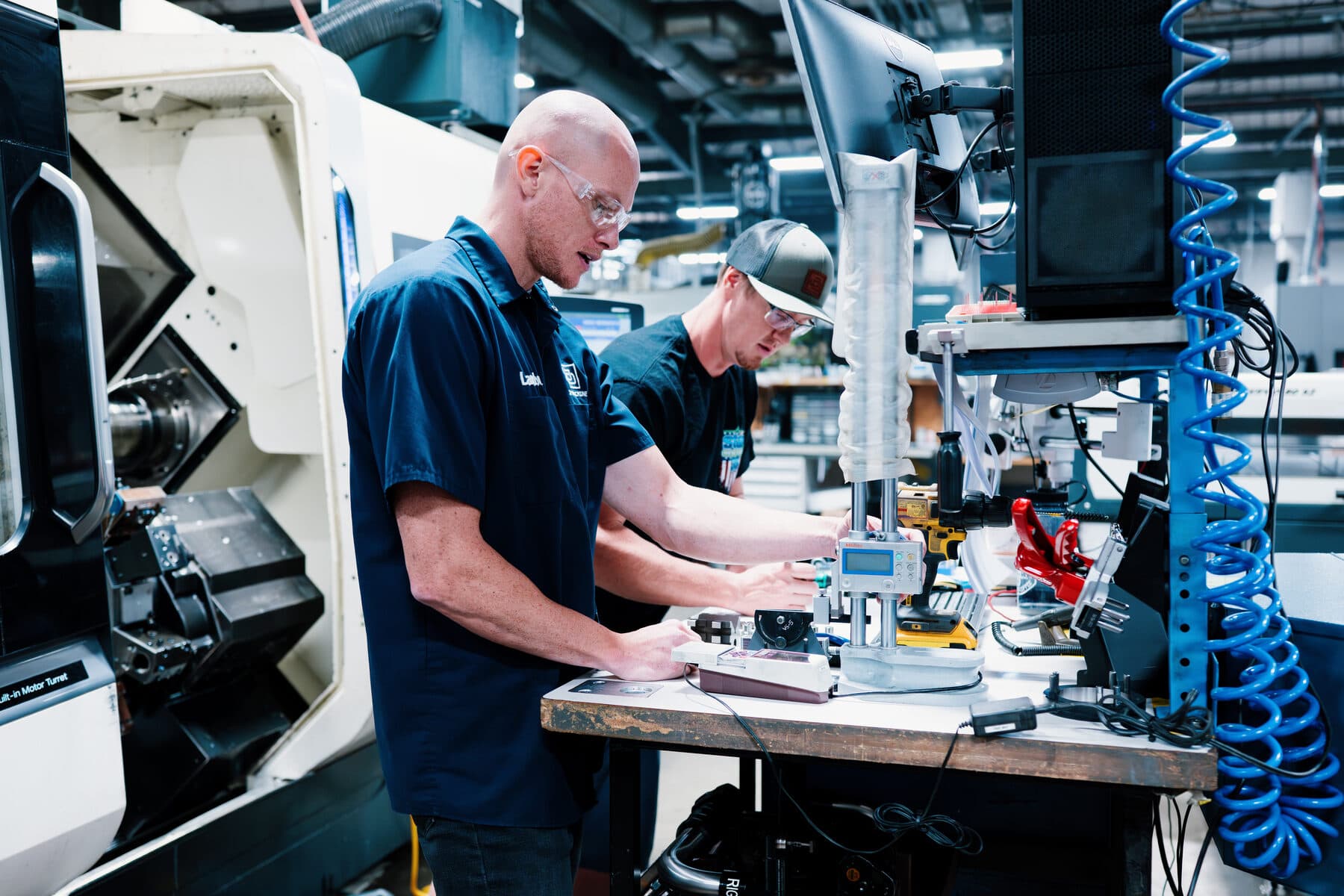
Most searchers treat Ogden as a fallback to Salt Lake City for manufacturing work. The local data points the other way. This post lays out the labor base, pay bands across machinist tracks, the training pipeline, and the Ogden cost-of-living math against Salt Lake. JD Machine has run a 70,000 sq ft facility in Ogden since 1979 with 225+ team members.
Key Takeaways
- Northern Utah (Davis, Morgan and Weber counties) supported 32,386 manufacturing jobs in 2023, equal to 12.0% of all area jobs (Utah DWS).
- Ogden-Clearfield employed 1,260 machinists at a $61,150 mean annual wage in May 2024 (U.S. Bureau of Labor Statistics).
- Ogden's median home value is $355,600 against $539,500 in Salt Lake City (U.S. Census Bureau).
Why Ogden Is a Real Manufacturing Market, Not a Backup to Salt Lake
According to the Utah Department of Workforce Services, Davis, Morgan and Weber counties supported 32,386 manufacturing jobs in 2023 — 12.0% of area employment.
The assumption that Salt Lake City is the center of Utah manufacturing breaks against the actual data. Ogden-Clearfield employed 1,260 machinists at a $61,150 mean annual wage in May 2024, per the U.S. Bureau of Labor Statistics. That figure sits inside a larger transportation equipment manufacturing base.
The region employed 10,755 workers in transportation equipment manufacturing at an $8,288 monthly average wage in 2024 (Utah DWS). The cluster is not a single-employer story; it is a regional concentration of companies that supports more manufacturing work than any one job board snippet shows.
The Ogden-area employer roster anchors the point:
- Hill Air Force Base — 25,000+ employees in the area, military and civilian (Ogden City Economic Development)
- Northrop Grumman — 2,000 to 2,999 local employees
- Williams International — 500 to 999 local employees, with a 2025 expansion adding more than 300 jobs and over $1 billion in investment (Ogden City)
- JD Machine — 225+ team members at our facility on Parkland Boulevard in Ogden, UT 84401, running CNC machining for aerospace, defense and medical customers
Market size sets the floor. Most readers want to know what the paychecks behind manufacturing jobs in Ogden, Utah actually look like.
What Machinist Pay Actually Looks Like in Ogden
Machinist is a category, not a single position. The Ogden labor market shows distinct pay bands across operator, programmer and supervisor roles, each with its own qualifications, schedule and skills profile.
CNC machine operator (entry track)
According to the U.S. Bureau of Labor Statistics, Ogden-Clearfield employed 120 computer numerically controlled tool operators at a $52,390 mean annual wage in May 2023. The job is built around loading material, running programs already proven out, in-process inspection, and keeping a safe, clean cell across a typical 40-hour week. Safety protocols and technical standards are required from day one.
Most operator hires come in with a short technical certificate and learn the rest on shift, where reading prints and holding standards is what moves people up. CNC milling cells are a common entry point.
CNC machinist and programmer (advanced track)
Per the U.S. Bureau of Labor Statistics, Ogden-Clearfield reported 30 CNC tool programmers at an $81,370 mean annual wage in May 2023.
This is the band where setup work, CAM programming and tight-tolerance experience push compensation up. Statewide, Utah machinists show a $29.06 per hour median wage per the Utah Economic Data Viewer, and the Ogden programmer figure sits well above that line because the role owns first-article approval on complex parts. CNC turning work tends to land here once an operator has logged a few thousand hours on the floor.
Production supervisor and lead roles (advancement track)
- First-line production supervisor: $73,990 median in Ogden Metro (Utah Economic Data Viewer)
- The pathway typically runs operator → machinist → setup/programmer → cell lead → supervisor
- Most advancement happens inside one shop, not by job hopping
Experience plus ERP-aware shop habits reward team members who own cell output, read prints and hold tolerances. Pay matters, but the path from no shop experience to machinist is what most readers actually need to plan for.
How Locals Become CNC Machinists Without Leaving Ogden
A four-year degree is not the entry requirement for CNC machinist jobs in Ogden. The training pathways feeding the shop floor sit inside the city:
- Start at Ogden-Weber Technical College's CNC Machine Operator program — a five-month track, $600 tuition plus $801.45 in materials and a next start date of July 13, 2026.
- Move into OTECH's Machining Technology program for broader fundamentals across mills, lathes and inspection (16 months; OTECH reports a $55,000 average graduate salary, a school-reported figure rather than a market mean).
- Continue at Weber State University's Manufacturing Engineering Technology program for coursework in CNC, metal forming and process automation if engineering or programming is the goal.
- Enter a DOL-certified apprenticeship like JDU at JD Machine for paid on-the-job training plus classroom hours, where the work is real production and experienced machinists do the teaching.
Ogden City reports more than 2,500 students complete engineering and manufacturing programs at area colleges each year, which is why local employers do not need to import their workforce. Our Training & Education page lays out how that pipeline feeds JD Machine specifically.
Training is one part of the decision. The other is whether the Ogden lifestyle actually pays off against commuting south.
Ogden vs. Salt Lake City: The Real Career Economics
| Factor | Ogden | Salt Lake City |
|---|---|---|
| Median owner-occupied home value | $355,600 | $539,500 |
| Mean travel time to work | 22.5 minutes (Weber County: 23.3 min) | Longer metro commute typical |
| Manufacturing cluster proximity | Hill AFB, Northrop Grumman and Williams International within minutes | Cluster sits 35–45 miles north |
Sources: U.S. Census Bureau QuickFacts; Ogden City Economic Development.
The pay difference between Ogden and Salt Lake City for the same machinist role is small. The cost difference is not. A machinist earning the Ogden-Clearfield mean of $61,150 keeps more of that wage when the local housing benchmark costs $184,000 less, and a 22.5-minute commute beats most Salt Lake metro routes by a wide margin.
That math is why applying locally beats chasing every opening south of the line. Our culture and a day in the life both lean on team members who chose to build a career here rather than commute.
Frequently Asked Questions
What do machinists make in Ogden, Utah?
The Ogden-Clearfield machinist mean wage was $61,150 in May 2024, per the U.S. Bureau of Labor Statistics. The Utah Economic Data Viewer puts the statewide median at $29.06 per hour. Pay varies materially by track: operator roles sit lower, while CNC programmer and supervisor roles push well above the mean.
Do I need a degree to become a machinist in Utah?
No. Most Ogden machinists enter through short-cycle technical training or apprenticeships rather than four-year degrees. The fastest local entry is Ogden-Weber Technical College's five-month CNC Machine Operator program. JD Machine also runs JDU, a U.S. Department of Labor-certified apprenticeship that pays you while you learn the trade on production work. See current openings in Ogden for active apprentice and operator roles.
Are manufacturing jobs in Utah still stable in 2026?
Utah's manufacturing base remains large. Per Utah DWS, statewide manufacturing employed 98,930 workers at a $6,277 monthly average wage in 2024, though the sector contracted by 1,100 jobs year over year as of April 2026, with statewide unemployment at 3.8%. Ogden-specific growth is moving the other direction, with Williams International's 2025 expansion adding 300+ jobs locally.
What companies hire machinists in Ogden besides Hill Air Force Base?
Northrop Grumman, Williams International and JD Machine each maintain hundreds to thousands of Ogden-area roles in machining, fabrication or assembly. Per Ogden City Economic Development, Northrop Grumman employs 2,000 to 2,999 in the area and Williams International 500 to 999. Statewide, Utah supports 2,919 workers across 220 establishments in machine shops, turned product, and screw, nut and bolt manufacturing (Utah DWS, 2024).
How many machinist job openings open up in Utah each year?
The Utah Economic Data Viewer projects roughly 480 annual machinist openings statewide. That figure represents projected openings — new roles plus replacement from retirement and turnover — not posted job listings, which is why the number looks smaller than what searchers see across job boards in any given week.
Can you start in manufacturing and move up without leaving the shop floor?
Yes. Operator-to-machinist-to-supervisor pathways are standard, and first-line production supervisors in Ogden Metro show a $73,990 median wage per the Utah Economic Data Viewer. Advancement is a within-shop progression at most local employers, where team members move from operator into setup, programming and lead roles over time. See JD Machine's culture for how that progression is structured.
What schools or training programs in Ogden lead into machining jobs?
Ogden-Weber Technical College, Weber State University's Manufacturing Engineering Technology program, and JDU all feed local machine shops. OTECH runs short-cycle CNC operator and machining technology programs; Weber State covers the engineering and programming side. Ogden City reports more than 2,500 students complete engineering and manufacturing programs at area colleges each year. JDU apprenticeship is the in-house DOL-certified option that pairs paid work with classroom hours.
Is Ogden cheaper than Salt Lake City for a manufacturing career?
Yes. Per the U.S. Census Bureau, Ogden's median owner-occupied home value is $355,600 against $539,500 in Salt Lake City. Weber County's median household income runs about $90,005, which means the housing differential translates into buying power for a manufacturing wage rather than getting absorbed by lower local pay.