


Culture and Values at JD Machine
Family-owned since 1979. A Top 50 Workplaces in Utah honoree by team-member survey. The culture is the operating model, not a poster on the wall.
Most companies talk about culture. The honest test is whether the culture shows up in the structures, the decisions, and the daily work. At JD Machine, it does, because the people who built the company are still here, and the people they hired and trained are still here too.
This page documents what culture looks like operationally: how values translate into decisions, how family ownership shapes the working environment, what the workplace credential actually measures, and how the culture holds across the full career arc from first day to retirement. The founding story and the daily walk-through live on their own pages.
Three Values, Practiced Daily
JD Machine has held to three values across 48 years:
Hard Working and Tenacious
Shows up in the work ethic at the cells, the willingness to stay with a difficult program until it runs right, and the lean discipline that drives improvement rather than acceptance of variation.
Respect for Everyone
Shows up in how journey-level team members coach apprentices, how the shop floor and the office speak to each other as one team, and in a Top 50 Workplaces credential earned through anonymous team-member surveys.
Integrity in All That We Do
Shows up in the quality systems, the traceability that aerospace and defense customers require, and the 99.6% customer quality rating sustained across 48 years.
The values aren't slogans. They're how the company makes decisions when no one's watching.
What Family Ownership Looks Like at 230+ Team Members
JD Machine is owned by the Wardle family. J. Don and Mary Ann founded the company in 1979. Their son Matt took ownership in 1992. All three of Matt's children are now in the business, and every department has a planned succession path. That ownership structure is unusual for a precision manufacturer at this scale.
The operational consequences show up in three places. First, the time horizon: family ownership thinks in decades, not in quarterly earnings, which means long-term agreement customers and long-term team members both get the stability that comes with that horizon. Second, the floor presence: the owner walks the shop and knows team members by name. Third, the succession discipline: every department has a path, so career progression isn't a marketing claim, it's a structural fact.
The company is big enough to offer modern equipment, real career paths, and the credentials that regulated industries require. Small enough that decisions don't get lost in three layers of corporate review.
A Top 50 Workplace, Awarded by Team Members
JD Machine has been recognized as a Top 50 Workplaces in Utah honoree through The Salt Lake Tribune's Top Workplaces program. The relevant detail for prospective applicants is the methodology: the program ranks companies based on anonymous employee surveys covering leadership, alignment, engagement, and connection. Team members rate their own workplace; the company doesn't write the survey or curate the responses.
That methodology is the credential's value. A company can put any claim on a careers page. A Top Workplaces ranking is harder to spin, because the people who would have to spin it are the same people answering the survey honestly and anonymously.
The credential lives alongside the others on the Awards page. It's surfaced here because it's the one that matters most to candidates evaluating where to work.
Culture Across the Career Arc
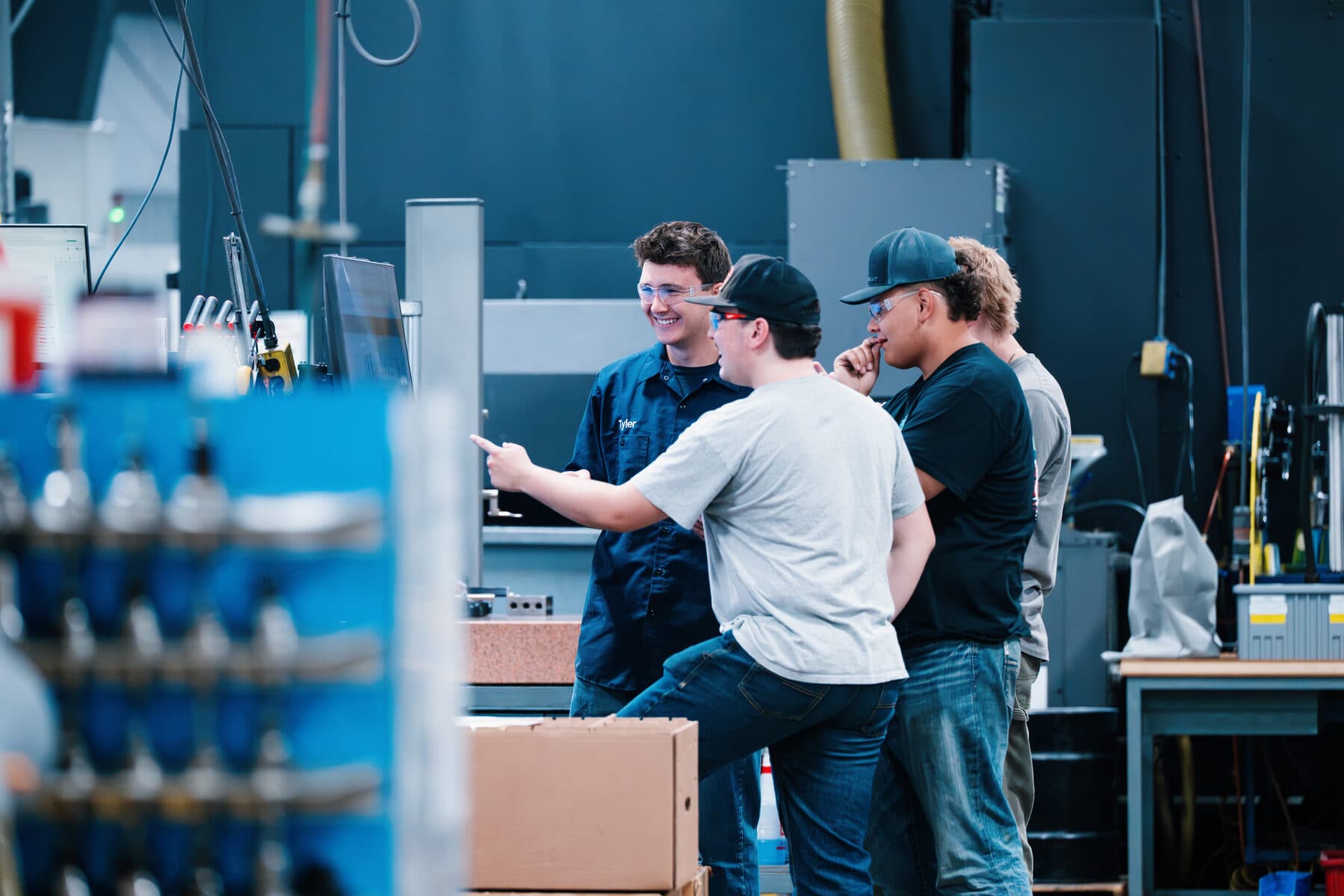
The clearest sign that culture is real is whether it holds over time. At JD Machine, the same culture meets a new hire on day one, an apprentice halfway through JDU, a journey-level machinist in their tenth year, and a department lead approaching retirement.
The mechanisms that hold it are structural. Apprentices are paired with experienced team members from day one, which transmits both skill and culture in the same moment. Continuous Improvement gives team members at every level the authority to shape how their own work runs, which builds ownership rather than compliance. Succession paths in every department mean that the culture is being modeled by people who came up through it, not imported from outside.
The result is what the Top 50 Workplaces credential measures: a workplace where people stay, advance, and recommend the company to others.
If the Culture Fits
Open positions are listed on our job board. We review applications as they come in.
(801) 782-4394