

Spindle count and machine inventory are misleading proxies for high volume capacity. What actually carries repeat production is the operating stack underneath the floor: ERP visibility, QMS discipline, scheduling rigor and workforce depth. JD Machine has run lean manufacturing since 1998 and holds AS9100D, ISO 9001:2015 and CMMC Level 2 certifications, so the systems argument is one we make from the inside.
Key Takeaways
- High volume reliability lives in ERP, QMS and traceability discipline.
- NIST MEP listed 76 open supplier scouting opportunities as of May 29, 2026.
- Certifications like AS9100D and CMMC Level 2 matter operationally, not as badges.
- Procurement should compare shops by ERP visibility and workforce depth.
- Mid-market manufacturers combine Tier 1 systems with faster decisions.
What “High Volume” Really Means in CNC Machining
Per NIST MEP, federal-side demand for domestic suppliers is active and specific.
According to NIST MEP, 76 open supplier scouting opportunities were active as of May 29, 2026, reflecting current federal-side demand for U.S. manufacturers with specific production and technical capabilities.
High volume CNC machining is not a part-count threshold. It is a capability profile: a precision machine shop that holds tolerance, traceability and on-time delivery across repeat production at the same level it hit on the first article. That is what procurement teams are actually buying when they qualify a supplier for sustained production runs.
What “high volume” actually requires:
- Documented repeatability across runs through SPC discipline and capable CNC machining processes that manufacture parts to specification.
- ERP visibility into work-in-process, capacity and on-time data, so the supply chain plan matches what the shop floor can deliver.
- A QMS that supports first article through PPAP-style discipline and ties business requirements to production routing and process controls.
- Workforce depth across shifts, not a thin operator bench expected to create output under surge conditions.
- Domestic supply chain reliability with verified capability — the framing NIST applies to its scouting work.
Those capabilities all live in the shop's operating systems, which is where the next section starts.
Why Systems Maturity Is the Real Capacity Constraint
Systems decide whether a shop holds high volume reliability. Machine count without ERP, QMS and bench depth produces missed dates and audit findings, regardless of how many cells appear on the tour.
The real capacity constraint is the integration between scheduling, quality and people. A capable management layer turns spindle hours into committed schedule, and the supporting technology and resources make that commitment auditable.
ERP as a capacity tool
ERP visibility into WIP, capacity and on-time performance is what turns shop floor activity into committed schedule. NIST MEP's 2025 case study on continuous improvement tied ERP and capacity planning directly to lead time reduction and quality outcomes, not back-office cost reduction.
According to NIST MEP's 2025 case study on continuous improvement and scheduling, ERP and capacity planning improvements were central to reducing lead times for a precision manufacturer.
JD Machine runs M1 ERP integrated with a lean manufacturing approach embedded since 1998. Real-time data on every cell flows into the same end-to-end view procurement teams need to verify status, which is what makes ERP a procurement-side asset and not just an internal back office.
QMS and process discipline
A mature QMS is what keeps process flows aligned with operational excellence under audit pressure. JD Machine's quality systems layer operates against the following points:
- Document control and traceability from PO through delivery.
- PFMEA-driven Standard Work Instructions for assembly and inspection processes.
- CAPA and internal audit cadence under AS9100D.
- SPC and inspection data captured on the shop floor in real time.
- First article and source inspection workflow that survives surge orders without rework loops.
Poor communication between scheduling, quality and production teams creates the very definition of a capacity constraint, which is why integrated systems matter more than machine count.
Workforce depth is capacity
Per the U.S. Bureau of Labor Statistics, machinists held about 299,500 jobs and tool and die makers about 55,200 jobs in 2024, which is why workforce depth across shifts is a real capacity signal.
The data point matters because cross-functional teams and employee adoption of process discipline are what keep a shop's bench staffed under load. A shop's training pipeline through OJT and the JDU apprenticeship program is what carries that bench through the implementation stage of a new program and through the production runs that follow.
Knowing systems matter is one thing. Building an evaluation around them is another.
How to Evaluate a Precision Machine Shop for High Volume Work
Procurement evaluation runs cleanest on five axes: ERP visibility, QMS maturity, traceability, workforce depth and surge response. Quoted lead time alone tells a buyer nothing about whether the supply chain plan survives an engineering change order or an audit.
| Evaluation axis | Mid-market advanced manufacturer | Small job shop |
|---|---|---|
| ERP visibility | Full ERP (e.g. M1) with real-time WIP, capacity and on-time data | Spreadsheets or basic MRP; limited WIP transparency |
| QMS maturity | AS9100D + ISO 9001:2015; CMMC Level 2 for defense; documented CAPA cadence | ISO 9001 baseline if any; informal CAPA |
| Traceability | Lot, heat and serial traceability built into routing | Lot-level when asked |
| Workforce depth | 200+ team across functions; cross-trained; formal apprenticeship pipeline | 10–40 operators; single-shift risk |
| Surge response | Scheduling system absorbs surge; LTA-friendly capacity reservations | Hand-scheduled; quote-by-quote |
The gap is not size for size's sake. It is the systems and bench depth that decide whether scheduled production survives engineering changes, audit prep and surge orders without slipping. NIST MEP Supplier Scouting frames supplier matching as capability verification across exactly those axes, which is the same lens that should anchor the relationship between buyer and supplier.
The mid-market column is also where vendor managed inventory stops being a back-office service and starts being a planning process buyers can build LTAs around. That is the competitive separation The JDM Difference makes operational for middle-market manufacturers carrying regulated work.
A verifiable checklist for procurement:
- Confirm the shop's ERP supports real-time WIP and capacity visibility.
- Verify AS9100D and (if defense) CMMC Level 2 registration in SPRS.
- Request a documented CAPA example with closure timeline.
- Ask for cross-shift workforce headcount and apprenticeship pipeline.
- Review a sample first article inspection workflow.
Certifications appear repeatedly above, which raises the next question: what do they actually prove operationally?
Certifications and What They Mean Operationally
Certs are not logos. They are audit-driven operating obligations that shape how a shop documents, traces and corrects work. NIST quality management guidance frames AS9100 as the path for suppliers conforming to aerospace requirements and qualifying as suppliers to large aerospace OEMs. Read that as: AS9100D is not a marketing badge, it is a contract precondition.
What each credential actually enforces:
AS9100D
Aerospace QMS layered on ISO 9001:2015. Drives risk management, FOD control, configuration management, and product safety processes that protect customers.
ISO 9001:2015
Documented QMS with internal audits, management review and CAPA. The floor, not the ceiling.
CMMC Level 2
C3PAO certified, SPRS registered: verified DoD cybersecurity practices for handling controlled unclassified information. Required for defense supply chain work going forward.
ITAR registration
Export control compliance for defense articles and technical data.
A shop's certifications only mean what its day-to-day audit, CAPA and traceability cadence make them mean. JD Machine has held AS9100D and ISO 9001:2015 through third-party registration by Quality Systems Registrars and carries a 99.5% customer quality rating against that system, with the tight tolerances and inspection discipline expected by aerospace and defense customers.
Certifications and systems converge on the same point: whether a mid-market shop can carry Tier 1 work without the drag.
Why a Mid-Market Advanced Manufacturer Closes the Gap
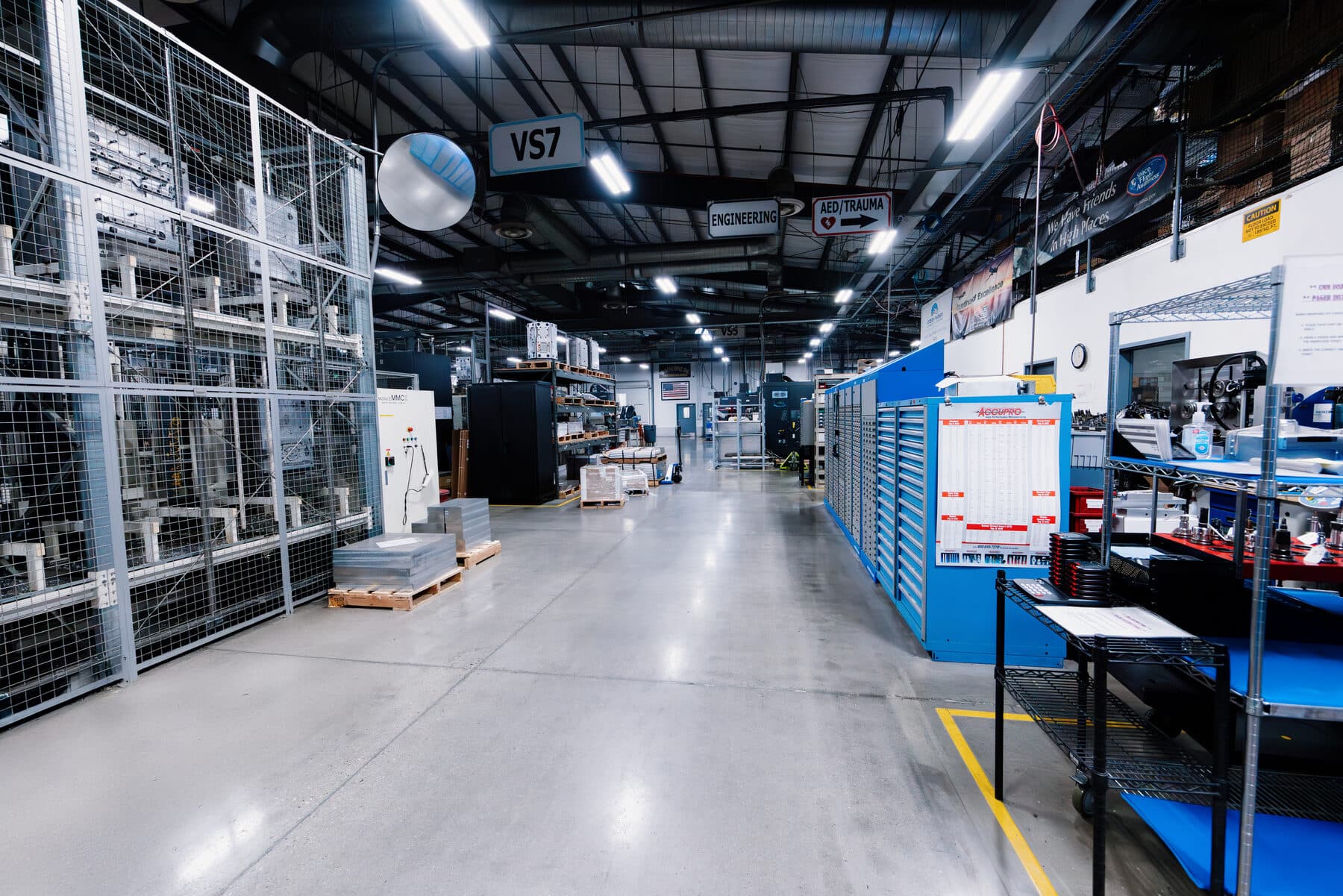
Mid-market means the systems and bench depth to carry high volume work, plus the decision speed a national contract manufacturer cannot match. JD Machine pairs 225+ team members across machining, fabrication, assembly and testing with M1 ERP, lean manufacturing embedded since 1998, and AS9100D + ISO 9001:2015 + CMMC Level 2 certification in a 70,000 sq ft climate-controlled facility.
JD Machine reports a 99.5% customer quality rating measured against AS9100D and ISO 9001:2015 systems, with a current backlog near $80 million across aerospace, defense, medical and industrial work.
That is the operational definition of a mid-market advanced manufacturer: Tier 1 systems and technology behind a mid-market response cadence, with quote turnaround in under one business day, a 50-unit MOQ, and LTA-preferred capacity. Procurement teams evaluating capacity can request a capacity overview to see how those capabilities line up against a specific program.
Frequently Asked Questions
What qualifies as high volume CNC machining?
High volume CNC machining means repeat production held to spec across runs, not just total part count. Quantity alone is misleading: a run of 50,000 units at drifting tolerance is not high volume capability. High volume capability is a shop's ability to hold dimensional repeatability, traceability and on-time delivery across sustained production, using ERP scheduling, QMS discipline and workforce depth that absorbs surge without slipping the schedule.
How do machine shops maintain quality at scale?
Through layered systems: documented QMS, SPC, traceability and operator training under AS9100D or ISO 9001:2015. Quality at scale is a systems output. Per NIST quality management guidance, AS9100 frames the operating requirements aerospace suppliers must conform to, which in practice means controlled documents, SPC on the floor, lot and serial traceability, CAPA discipline and internal audits. Shops without that infrastructure can hit one first article and miss the next 49, which is why buyers verify documented CNC machining workflows and ask how a shop holds tight tolerances across production runs.
Is high volume manufacturing more cost effective?
Yes, but only when systems hold quality and schedule. Poor systems convert scale into rework and missed dates. Scale lowers per-unit cost when amortizing setup, programming and tooling across longer runs. It raises total cost when a shop lacks ERP visibility and QMS discipline, because rework, expedites and quality escapes wipe out the unit-cost advantage. Buyers evaluating cost should look at total landed cost across the program, not just RFQ piece price.
What is ISO 9001 certification, and how does it differ from AS9100?
ISO 9001:2015 is a general QMS standard; AS9100D layers aerospace-specific requirements on top. ISO 9001:2015 sets the baseline QMS framework: document control, internal audits, CAPA, management review. AS9100D adds aerospace-specific requirements around risk management, configuration control, product safety and FOD prevention. NIST positions AS9100 as the path to qualifying as a supplier to large aerospace OEMs, which is why defense and aerospace buyers treat it as a contract precondition — and The JDM Difference shows how that runs in practice.
How should procurement teams compare machine shops for repeat production?
Compare on ERP visibility, QMS maturity, traceability, workforce depth and surge response, not quoted lead time alone. JD Machine's evaluation framework runs across those five axes: ERP-backed schedule visibility, AS9100D or CMMC Level 2 QMS maturity, lot and serial traceability, cross-trained workforce bench depth, and documented surge response. A shop that scores high on one axis and low on three is a single-program supplier, not a portfolio partner. More background on the operating model lives on the About JD Machine page.
Why does ERP matter in a precision machine shop?
ERP turns shop floor activity into committed schedule, capacity and quality data buyers can verify. It also enables Long Term Agreement structures, because it gives both supplier and buyer visibility into reserved capacity and material status. NIST's 2025 MEP case study on continuous improvement tied ERP-driven scheduling to lead time reduction and capacity planning, making ERP a procurement-side asset rather than a shop-side back office. Data visibility through ERP creates the foundation for supply chain partnerships that scale beyond transactional RFQs.
What should aerospace and defense buyers verify beyond certifications?
Verify CAPA records, traceability scope, CMMC SPRS registration, and the supplier's response under audit pressure. A cert badge does not prove operating discipline. Ask for a documented CAPA example with closure timeline, lot/serial traceability scope, CMMC Level 2 SPRS registration confirmation, and the date of the last C3PAO assessment. NIST guidance treats supplier scouting as capability verification, not credential checking, which is the lens buyers should bring to RFQ qualification across full precision CNC machining capabilities.
Can a mid-market manufacturer handle Tier 1 style requirements?
Yes, when systems, certifications and workforce depth match Tier 1 expectations without the bureaucratic drag. JD Machine carries Tier 1 style work with 225+ team members, M1 ERP, AS9100D + ISO 9001:2015 + CMMC Level 2 systems, and lean manufacturing embedded since 1998. The mid-market advantage shows up in decision speed: quote response in under one business day, direct access to engineering and quality leads, and LTA-friendly capacity reservations rather than multi-tier procurement queues. This service model delivers precision manufacturing services at the quality level large OEMs require while maintaining the responsiveness that program managers need.
What makes a precision machine shop reliable at high volume?
Reliability comes from ERP scheduling, QMS discipline, traceability, and a workforce bench that absorbs surge. Reliability at high volume is not a marketing claim; it is the cumulative output of ERP-backed scheduling, AS9100D-grade QMS discipline, lot and serial traceability, and a cross-trained workforce. Per the Bureau of Labor Statistics, machinists held about 299,500 jobs in 2024, which is why shops with deep training pipelines and apprenticeship programs out-perform shops competing for the same thin operator pool. Most manufacturers without formal apprenticeship programs rely on external hiring rather than internal development, which is the bench depth gap customers feel under surge.
When does a smaller job shop make more sense than a larger supplier?
For one-off prototypes, low-documentation work, or highly specialized single-process jobs with no audit burden. Smaller job shops win on short setup runs, single-process specialization and minimal documentation burden. Mid-market and larger suppliers win on repeat production, multi-process consolidation across machining, fabrication, assembly and test, regulated-industry documentation, and schedule risk control. The decision is about program profile, not vendor size, and NIST Supplier Scouting frames it as capability matching across business models, not vendor preference.