


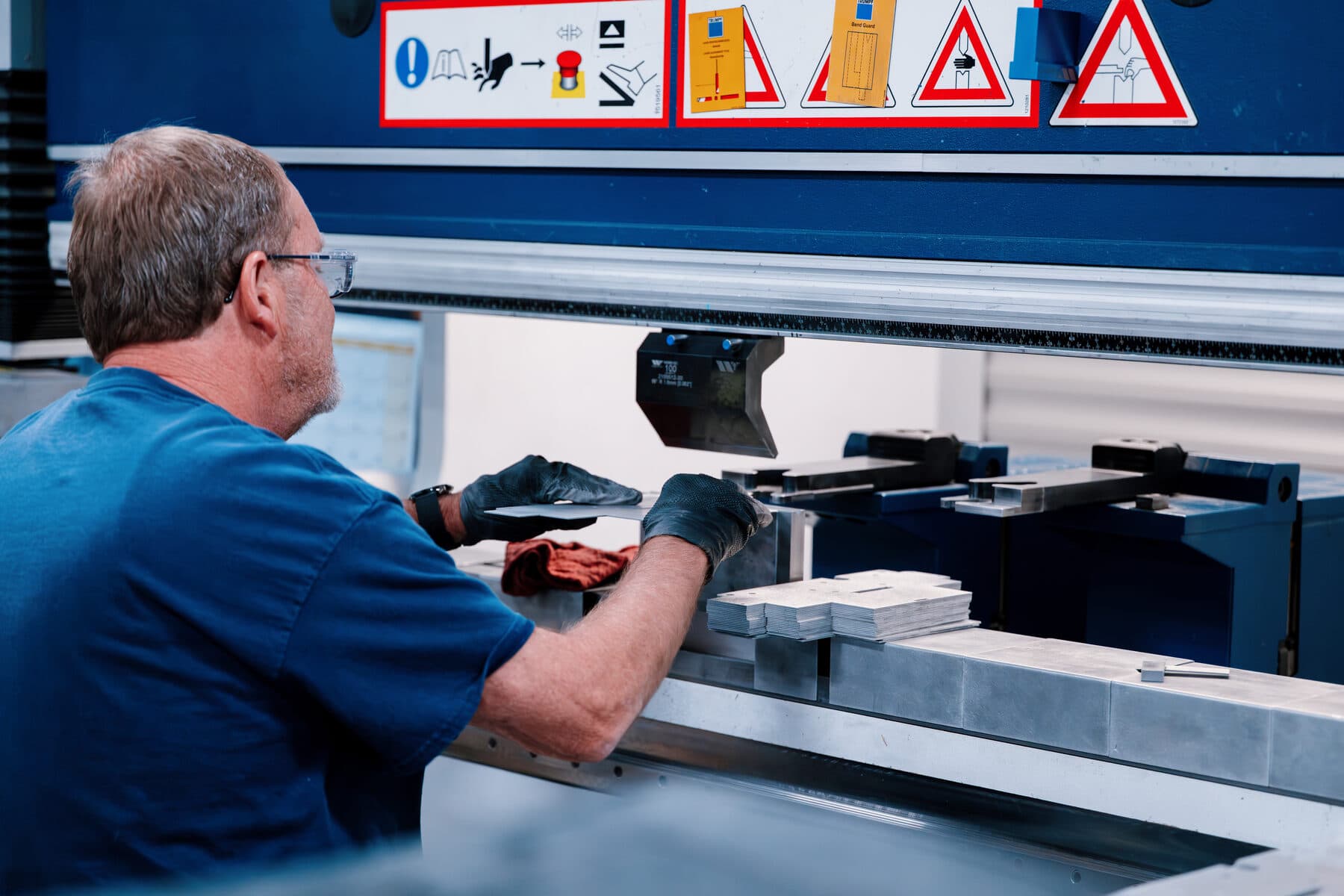
AS9100 on a supplier's website tells you the shop has a quality management system. It does not tell you they can pass an AS9102 First Article Inspection, hold tolerance on formed features, or trace material through every special process. The five specs below are what procurement actually screens for in aerospace sheet metal fabrication, and they sit at the center of how JD Machine runs sheet metal work inside the same QMS as our CNC machining.
Key Takeaways
- AS9100D certification is the floor for aerospace sheet metal fabrication, not the proof.
- SAE's AS9102 standard is at revision AS9102C, verified June 28, 2023; ask suppliers which form set they run.
- Five specs separate aerospace-capable shops from general job shops: AS9102 FAI, special process control, formed-part tolerance control, FOD prevention, and traceability.
- Formed parts add springback risk that flat-cut accuracy does not solve.
- Receiving inspection at FAA-regulated operators now hinges on traceability documentation, not visual conformance.
What aerospace sheet metal fabrication actually requires
Aerospace sheet metal fabrication is not a process. It is a process discipline overlay sitting on top of the same physical operations a general fab shop already runs: laser cutting, forming, bending, welding and finishing. The equipment list does not make a shop aerospace-capable. The documented control of every step does, which is why AS9100D quality systems function as the framework rather than the finish line.
What aerospace adds beyond general sheet metal fabrication:
- Documented First Article Inspection per AS9102, with Forms 1, 2 and 3
- Special process control for welding, finishing and heat treat under NADCAP-style discipline
- Variation management for key characteristics on formed sheet metal parts
- A FOD prevention program tied to SAE AS9146
- Material and special-process traceability from receiving through shipment
Each of these five disciplines is a separate screening axis in procurement. JD Machine's fabrication and machining capabilities sit inside one AS9100D system, and the next section unpacks what each spec proves for aircraft components and defense work.
Five specs that define aerospace-capable sheet metal fabrication
SAE's AS9102 standard is at revision AS9102C, verified June 28, 2023. The supplier you are screening should be able to tell you which form set they run.
1. AS9102 First Article Inspection (FAI)
AS9102 First Article Inspection is the supplier's documented proof that their sheet metal fabrication process produced a conforming first article. Form 1 captures part accountability, Form 2 captures material and special process records, and Form 3 captures dimensional characteristics tied to design data.
The IAQG positions FAI as validation that the production process can produce sheet metal parts meeting engineering and design requirements, which is how you reduce future escapes before they reach assembly. Holding AS9100D and ISO 9001:2015 certifications does not produce an FAI packet; the documented process does.
What should I ask? Ask which SAE AS9102 revision the supplier runs, and request a redacted Form 1, 2 and 3 from a recent aerospace job.
2. Special process control
Special processes are operations you cannot fully verify by inspecting the finished part. They require documented qualification at the process level, not at the part level. Typical scope:
- Welding, per the applicable AWS specification with welder and procedure qualification records
- Finishing, including chemical processing, anodize and coatings under controlled-batch records
- Heat treat with calibrated furnace records and conformance certs
- Non-destructive testing performed by qualified Level II or III personnel
If a shop cannot produce qualification records on demand, the process is not under control regardless of the visual condition of the finished part. A secure record system covering every special process is what separates a credible aerospace machine shop from a general fabricator.
3. Formed-part tolerance control
Tolerance control on formed sheet metal parts depends on process capability after forming, not laser-cut accuracy before forming. Springback variation, tooling wear and material lot differences shift formed geometry in ways that flat-blank measurements never expose. NIST has published a dedicated springback robustness study, and IAQG 9103 applies variation management logic to assemblies and all levels of parts, including formed features tagged as key characteristics.
Stamping and forming operations on aluminum, stainless steel and copper alloys each create distinct springback profiles, and the final shape depends on how the shop controls those profiles across different metals and thicknesses. Precision sheet metal fabrication requires documented control of formed-feature geometry, not just flat-blank accuracy.
What separates a real tolerance answer from marketing? Ask how the shop manages key characteristics on formed features, not how tight their laser cuts flat blanks. Ask whether bending operations maintain documented process capability across production runs.
4. FOD (Foreign Object Damage) prevention
SAE's AS9146 FOD prevention standard was reaffirmed September 8, 2022, defining FOD prevention program requirements for aviation, space and defense organizations.
FOD discipline starts upstream in fabrication and handling, not at final assembly. Shadowed toolboxes, controlled work-cell housekeeping, FOD logs inside fab cells, and tethered tooling are the visible program markers.
When fab-shop FOD discipline is loose, the cost compounds downstream in assembly and testing, where the part is hardest to inspect and the consequence of a missed chip or fastener is highest. SAE AS9146 is the program reference to cite when you write the requirement into your purchase order for aircraft components.
5. Traceability
Traceability is what receiving inspection at an FAA-regulated operator now hinges on. Three records have to line up:
- Raw material certifications matched to heat or lot, including chemistry and mechanical properties for metals such as aluminum, stainless steel, copper and brass
- Special process records, including welder certification, finishing batch numbers and NDT reports
- Inspection equipment records traceable to calibration source and standard
If any of the three is missing, the part lands in a nonconformance queue at receiving regardless of how it looks on the dock.
Comparison: aerospace fab shop vs. general job shop
U.S. aerospace product and parts manufacturing employed 563,800 people in June 2025, while fabricated metal product manufacturing employed 1,031,500 in 2025, per the Bureau of Labor Statistics.
The aerospace-specialized labor pool is roughly half the size of the broader fab manufacturing pool. The screening implication is that an aerospace-capable supplier is a specialized subset of the metal fabrication market, not the default.
| Decision axis | Aerospace-capable fab shop | General job shop |
|---|---|---|
| FAI readiness | AS9102 Forms 1, 2 and 3 produced from a documented process | Best-effort first piece inspection, no AS9102 alignment |
| Documentation packet | Material certs, special process records, inspection equipment trace, dimensional reports | Material cert and CoC at most |
| Tolerance approach | Variation management on key characteristics after forming, per IAQG 9103 | Flat-blank accuracy plus visual conformance on formed features |
| Shipment gate | Customer FAI approval before shipment (e.g. Northrop Grumman SQAR requirement) | Pack and ship on internal QC sign-off |
Tolerance approach reference: IAQG 9103, Variation Management of Key Characteristics.
The right answer depends on the part. Flight-adjacent, defense and customer-quality-clause work needs the left column, and the industries we serve all sit on that side of the line. Noncritical commercial fabrication can run from the right column at lower price without compromising safety or production efficiency.
Treating the two as interchangeable suppliers is where program risk enters the picture. Documented process control remains the primary screening criterion, which is why lean manufacturing discipline matters more on the aerospace side than equipment variety. Aerospace contract manufacturing carries documentation and traceability overhead that general job shops do not maintain, and that overhead is built into every quote and every shipment of finished assemblies to aerospace customers.
How to put the five specs into your supplier RFQ
The checklist below translates the five-spec framework into procurement language. OEM supplier-quality documents already define this language, and adapting it into your RFQ is more effective than reinventing it.
Lockheed Martin Procure-2-011 (effective December 7, 2025) details AS9102 Form 2 and Form 3 inputs covering raw materials, special processes and inspection equipment. Northrop Grumman SQAR requires AS9102 FAI completion before shipment. Align these clauses with the broader precision machining and fabrication scope you expect from the supplier.
- Specify AS9102 FAI per current revision (AS9102C) with Forms 1, 2 and 3
- Require raw material certs traceable to heat or lot
- List special processes (welding, finishing, NDT) requiring documented qualification
- Require key characteristic identification and variation data on formed features
- Specify FOD prevention program per AS9146
- Require FAI approval before shipment authorization
If the answers come back with capability statements instead of documents and procedures, the supplier is not ready. To move from screening into evaluation, request a quote with the checklist clauses written in.
Frequently Asked Questions
What is aerospace sheet metal fabrication?
Aerospace sheet metal fabrication is sheet metal work performed under documented aerospace controls, including AS9102 FAI, special process control, and traceability. The distinction is not equipment: a general fab shop and an aerospace-capable shop may run the same lasers, press brakes and welders. The difference is the documented system overlaid on every operation, and the records that result. JD Machine's capabilities run sheet metal fabrication inside the AS9100D system that also covers our CNC machining work.
What certifications should an aerospace sheet metal fabricator have?
AS9100D for the quality management system, ISO 9001:2015 for general standards, and ITAR registration for defense work; NADCAP applies where special processes warrant it. Certifications are entry tickets, not proof of execution. AS9102C is the procedural overlay buyers should ask about specifically, because it tells you whether the shop can produce the FAI packet your program requires. Ask for sample forms, qualification records and a recent audit summary rather than a list of cert logos.
Is AS9100 enough for aerospace sheet metal work?
No. AS9100 is the QMS framework. FAI per AS9102 and traceability per FAA Advisory Circular 20-154A determine whether a shop can actually pass aerospace requirements. Certification confirms a system exists; execution confirms the system produces conforming parts with the records to prove it. A supplier with AS9100D and no recent AS9102 FAI history on file is a supplier whose system has not been exercised under aerospace conditions.
How tight are tolerances in aerospace sheet metal fabrication?
Tolerances vary by part, but ±0.005 inch is typical on flat features; formed features depend on process capability after forming, not pre-form cut accuracy. For reference, JD Machine's CNC milling holds ±0.001 to 0.005 inch on machined features, and sheet metal tolerances on formed geometry are set by the forming process capability rather than the laser. Asking a supplier for tolerance on formed features without asking how they monitor that capability produces an answer that does not predict the parts you will actually receive.
Why do formed sheet metal parts drift out of tolerance after tooling changes?
Springback variation, tooling wear and material lot differences shift formed-feature geometry; controlling them requires monitoring key characteristics, not just retuning the press. NIST has published a dedicated springback robustness study confirming this is a documented technical problem rather than a one-shop quirk. The fix is variation management on identified key characteristics with data collected after forming, in line with IAQG 9103 logic. Retuning the press after a reject is a symptom response, not process control.
How much documentation should come with aerospace parts?
Expect material certs, special process records, dimensional inspection reports, and AS9102 Forms 1, 2 and 3 for first articles, at minimum. FAA Advisory Circular 20-154A, issued July 3, 2024, centers receiving inspection on establishing sufficient traceability. If the documentation packet does not let the receiver reconstruct the full chain from raw material heat number through inspection equipment calibration, the parts will sit in a nonconformance queue regardless of dimensional condition.
What should I ask a supplier before moving an aerospace bracket or enclosure to them?
Ask for a recent AS9102 FAI sample, their FOD prevention program, special process qualifications, and key characteristic variation data on formed features. Frame each question to require evidence rather than a capability statement. Capability statements are written for websites; evidence is written for auditors. Suppliers who can answer with documents in the conversation are the ones who will deliver the same documents with your parts — and that is the distinction worth a follow-up call to talk to JD Machine.
How does JD Machine handle sheet metal fabrication for aerospace customers?
JD Machine runs sheet metal fabrication inside the same AS9100D system as our CNC machining, with full FAI capability and a 99.5% customer quality rating. Fab work is not a separate envelope from machining at our facility: the documented controls, special process qualifications and traceability records run through one system. That structure is part of the JDM Difference for procurement teams consolidating machining, fabrication, assembly and testing under a single AS9100D supplier.